
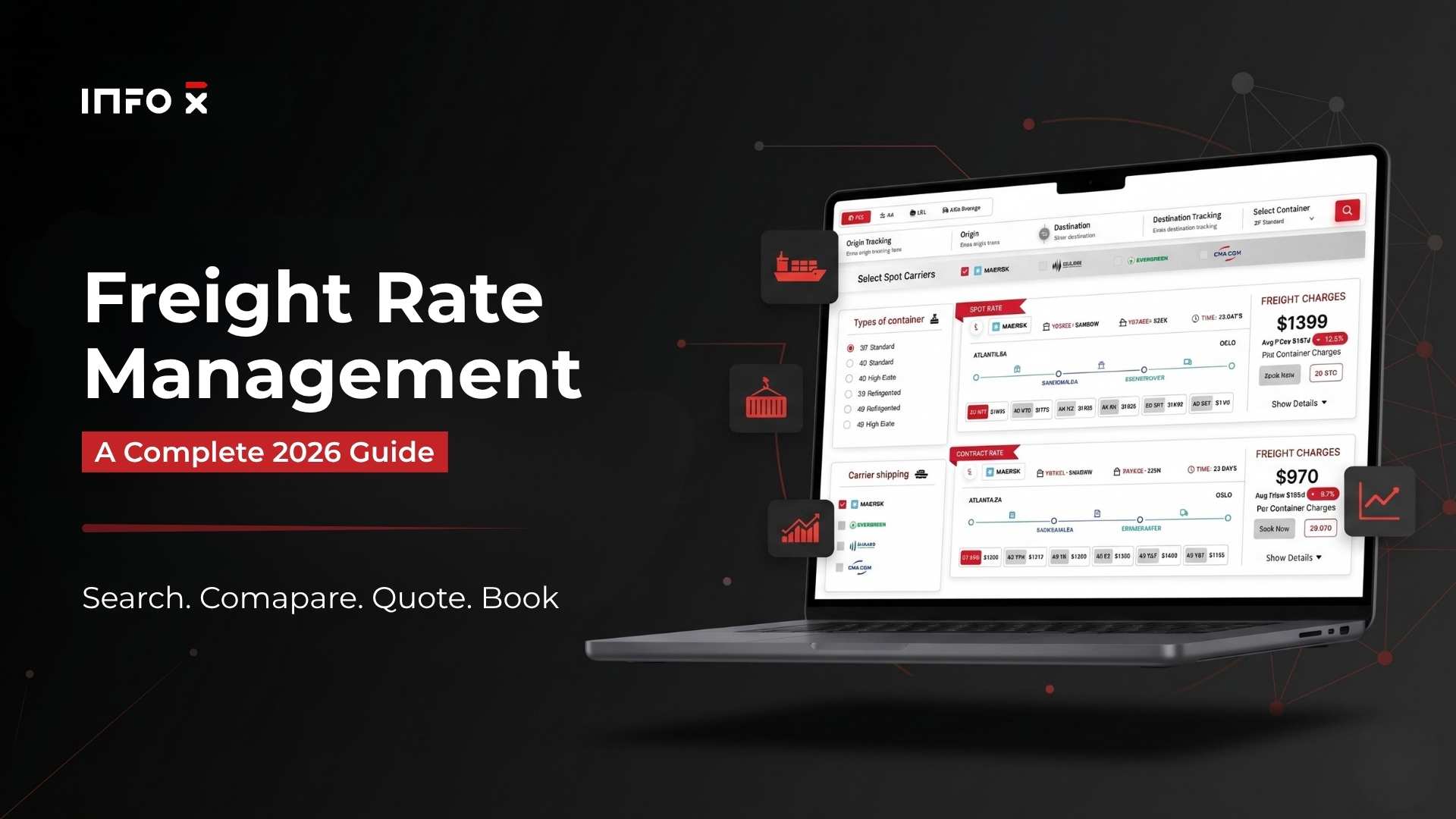
Freight rate management is the process of centralizing, comparing, and acting on carrier pricing data across ocean, air, and inland modes. For freight forwarders and NVOCCs operating in 2026, it is the foundation of profitable quoting, margin protection, and competitive positioning. This guide covers what rate management involves, why it matters now more than ever, how modern systems work, and what to look for when choosing a platform.
What Is Freight Rate Management?
Freight rate management is the structured process of storing, organizing, comparing, and applying freight pricing data across carriers, contracts, trade lanes, and transport modes. It ensures that every rate a freight forwarder, NVOCC, or BCO uses for quoting is accurate, current, and aligned with the latest carrier contracts, surcharges, and amendments.
In practical terms, rate management covers the full pricing lifecycle: receiving carrier rate sheets, normalizing them into a usable format, storing them centrally, applying surcharges and GRIs (General Rate Increases), tracking contract validity dates, comparing pricing across carriers for the same origin-destination pair, and ultimately generating customer-facing quotes that protect profit margins.
For freight forwarders handling multi-modal shipments across ocean, air, and inland transport, rate management is not an administrative task. It is the pricing intelligence layer that determines how fast you quote, how accurately you price, and how consistently you protect your margins.
Freight rate management is the backbone of pricing operations for logistics companies. Without a centralized, automated system, forwarders lose deals to competitors who quote faster, and they lose margin to outdated or inaccurate pricing.
Why Rate Management Has Become Critical in 2026
Rate management has always mattered, but several converging factors make it operationally essential in 2026.
Rate Volatility Is the New Normal
Ocean freight rates fluctuated by over 300% between 2020 and 2024. While the extreme peaks have normalized, the era of predictable quarterly rate cycles is over. GRIs, PSS (Peak Season Surcharges), BAF (Bunker Adjustment Factor), and emergency surcharges now arrive with greater frequency and shorter notice periods. Forwarders who rely on static rate sheets risk quoting from data that became outdated before the email reached the customer.
Shippers Expect Instant Quotes
Industry research consistently shows that shippers now expect freight quote responses within hours, not days. The average time to respond to a spot quote request across the industry sits at approximately 67 hours when managed manually. Forwarders using centralized rate management platforms reduce that response time to under 30 minutes. In competitive trade lanes, the first accurate quote frequently wins the booking.
Margin Erosion Is a Silent Killer
When rate data is scattered across inboxes, spreadsheets, and legacy systems, pricing errors compound. A missed $200 GRI across 50 shipments per month represents $10,000 in eroded margin per month, or $120,000 per year. A single incorrectly applied surcharge on a major account can trigger disputes that damage both profitability and trust.
Contract Complexity Has Increased
Carrier contracts now routinely include commodity-specific rates, named account pricing, tiered volume commitments, and dozens of conditional surcharges. Managing these variables across multiple carriers and trade lanes without a dedicated system is no longer feasible for forwarders handling more than a handful of contracts.
What Does a Freight Rate Management System Do?
A freight rate management system serves as the centralized hub for all pricing data within a logistics operation. Here is what it handles:
- Centralized Rate Storage. All carrier contracts, spot rates, tariff rates, and customer-specific pricing live in one searchable database. Sales, operations, and pricing teams access the same data instead of working from separate spreadsheet versions.
- Multi-Modal Rate Comparison. The system enables side-by-side comparison of ocean, air, and inland rates for the same origin-destination pair, including all applicable surcharges, transit times, and vessel schedules. This allows teams to recommend the best routing based on cost, speed, or service level.
- Surcharge and Amendment Management. Carrier surcharges, including BAF, CAF, GRI, PSS, EBS, THC, and dozens of others, are tracked and automatically applied to quotes. When a carrier issues an amendment, the system updates the affected contracts without requiring manual intervention on every rate sheet.
- Contract Tracking and Validity Management. The system monitors contract start and end dates, flags expiring contracts, and prevents quoting from expired rates. This eliminates a common source of pricing errors where teams unknowingly quote from a contract that is no longer valid.
- Margin Protection. Built-in rules ensure that sell rates maintain minimum margin thresholds. If a sales rep attempts to quote below the defined floor, the system flags it for review before the quote is sent.
- Integration with TMS and Booking Systems. Rate management platforms connect to Transportation Management Systems, booking engines, and accounting platforms through APIs, ensuring that the same rate data flows seamlessly from quote to booking to invoice without manual re-entry.
The Real Cost of Managing Rates on Spreadsheets
Spreadsheets remain the default rate management tool for many small and mid-size freight forwarders. While they offer flexibility, they introduce operational risks that scale with business volume.
| Factor | Spreadsheet-Based Management | Dedicated Rate Management System |
|---|---|---|
| Quote Speed | 2-6 hours average per quote | Under 5 minutes per quote |
| Surcharge Accuracy | Manual lookup, prone to missed GRIs | Automated, real-time surcharge application |
| Version Control | Multiple file versions, no audit trail | Single source of truth with full change log |
| Contract Expiry Alerts | Manual calendar tracking | Automated alerts before contract expiry |
| Margin Visibility | Calculated per-quote, easy to overlook | Built-in margin thresholds and flags |
| Multi-Modal Comparison | Requires switching between multiple files | Side-by-side ocean, air, and inland on one screen |
| Team Collaboration | Email attachments, local files | Cloud-based, role-specific access |
| Scalability | Breaks at 10+ carriers or 5+ users | Scales to thousands of contracts and dozens of users |
The cost of spreadsheet-based rate management is not visible on a balance sheet, but it shows up in lost bookings, eroded margins, customer disputes, and the operational hours consumed by manual data entry. For forwarders processing more than 100 shipments per month across multiple carriers, the return on investing in a dedicated rate management platform is typically realized within the first quarter.
Ocean, Air, and Inland: How Rate Management Differs by Mode
Ocean Freight Rate Management
Ocean rates are the most complex to manage. A single ocean carrier contract can include base rates by container type (20GP, 40GP, 40HC, 45HC), commodity-specific pricing, named account rates, seasonal surcharges, GRIs with varying effective dates, and dozens of accessorial charges tied to specific ports or terminals. Ocean contracts also require frequent amendments as carriers adjust pricing in response to market conditions, fuel costs, and capacity utilization. Effective ocean freight rate management requires a system that can handle this layered complexity without forcing the pricing team to reconcile data manually for every quote.
Air Freight Rate Management
Air freight rates change more frequently but have fewer surcharge layers than ocean. The primary complexity lies in weight-break pricing (minimums, +45kg, +100kg, +300kg, +500kg, +1000kg), dimensional weight calculations, carrier allocation commitments, and all-in versus base-plus-fuel pricing structures. Speed of quote response is even more critical in air freight, where cargo decisions are often made within hours.
Inland and Intermodal Rate Management
Inland rates, including trucking and rail, depend heavily on local market conditions, equipment availability, and fuel costs. Pre-carriage and on-carriage rates must be seamlessly integrated with ocean or air pricing to produce accurate door-to-door quotes. Forwarders who manage inland rates separately from their ocean and air pricing frequently discover margin leakage in the final mile.
Decision Guidance: If your operation handles shipments across multiple transport modes, your rate management system must support ocean, air, and inland rates within a single platform. Managing them in separate tools or spreadsheets introduces data gaps that lead to inaccurate door-to-door quotes and customer disputes.
Key Features to Look for in Rate Management Software
Not all rate management platforms deliver the same depth of functionality. When evaluating options, focus on these capabilities:
- Multi-carrier, Multi-modal Rate Database. The system must store and organize rates from all your carriers across ocean, air, and inland modes in a single searchable interface. This is the foundation. Without centralized data, every other feature is compromised.
- Contract and Spot Rate Handling. Your platform should manage both long-term contracted rates and short-term spot rates, with clear visibility into which pricing applies for each customer, lane, and validity window.
- Automated Surcharge Management. BAF, CAF, GRI, PSS, EBS, THC, and other surcharges should be automatically applied to base rates based on carrier rules and effective dates. Manual surcharge lookups are one of the largest sources of quoting errors in the industry.
- Rate Ingestion and Normalization. Carriers send rate sheets in different formats: Excel, PDF, email text, and EDI. The best platforms use AI and OCR to ingest these varied formats, normalize the data into a standard structure, and load it into the rate database with minimal manual intervention.
- Margin Controls and Analytics. Built-in margin thresholds prevent under-quoting. Analytics dashboards show lane-level profitability, win rates, and carrier utilization patterns, enabling data-driven pricing decisions.
- API and System Integration. The rate management system must connect to your TMS, booking engine, and accounting software. Platforms like Info-X provide built-in API connectivity for carrier bookings, shipping instructions, cargo tracking, and accounting integration.
- Vessel Schedule and Transit Time Data. For ocean freight, the ability to view carrier vessel schedules alongside rate data enables forwarders to recommend routing based on both cost and transit time, rather than cost alone.
How AI Is Changing Freight Rate Management
Artificial intelligence is no longer a future consideration for rate management. In 2026, it is reshaping how the most competitive forwarders and NVOCCs operate.
- Automated Rate Ingestion. AI systems can read unstructured carrier rate sheets from emails, PDFs, and Excel files, extract the relevant pricing data, normalize it, and load it into the rate database. This eliminates hours of manual data entry for operations teams that receive dozens of rate updates weekly.
- Instant Quote Generation. AI-powered rate quote automation enables forwarders to respond to rate requests in seconds. The system reads inbound rate request emails, extracts origin, destination, cargo details, and required mode, then matches the request against the rate matrix and generates a formatted quote automatically.
- Follow-Up and Conversion Optimization. AI agents can track quotes that have been sent but not yet booked, and automatically send follow-up communications to the shipper. This ensures that no viable booking opportunity falls through the cracks simply because the sales team was too busy to follow up.
- Anomaly Detection. AI identifies rate anomalies: contracts that are about to expire, rates that are significantly above or below market, surcharges that have not been applied correctly, and quotes that fall below margin thresholds. These alerts allow teams to correct issues before they affect customers or profitability.
- Predictive Analytics. Advanced platforms are beginning to offer predictive rate analytics that suggest pricing adjustments based on historical booking data, lane-level demand patterns, and carrier rate trends. This moves rate management from reactive to strategic.
For a broader view of how AI is reshaping logistics operations beyond rate management, including document processing, customs filing automation, and predictive visibility, Info-X's coverage of AI in freight forwarding in 2026 provides detailed context on where these capabilities are heading.
How to Choose the Right Rate Management System
Selecting a rate management platform is a decision that affects pricing accuracy, quoting speed, and margin performance across your entire operation. Here is what to evaluate:
- Does it support all the modes you operate? If you handle ocean, air, and inland, your system must manage all three on one platform. A system built only for ocean will force you to maintain separate tools for air and trucking, recreating the fragmentation you are trying to eliminate.
- Can it handle your surcharge complexity? Ocean freight surcharges alone can number in the dozens per carrier. Ask how the system manages surcharge rules, effective dates, and automated application. If surcharges require manual entry for every quote, the system is not solving your core problem.
- How does it integrate with your existing TMS? Rate data must flow seamlessly from the rate management system to your booking and operations workflow. Evaluate whether the platform offers API, EDI, or native integration with your current TMS. Retyping rates from one system to another introduces the same errors that spreadsheets create.
- What is the rate ingestion process? Ask how carrier rate sheets are loaded into the system. If the answer is "you upload Excel files manually," the platform is solving only half the problem. Look for AI-powered ingestion that can parse rate updates from carrier emails, PDFs, and varied spreadsheet formats.
- Does it include a back-office support option? Some forwarders want a software tool. Others want the rate management process fully managed by specialists. Platforms that offer both a self-service system and a managed back-office service provide the flexibility to scale without proportional headcount increases.
- What analytics does it provide? Look for dashboards that show lane-level profitability, carrier utilization, quote win rates, and margin trends. These insights transform rate management from an operational cost center into a strategic pricing function.
Centralize Your Freight Rates. Quote Faster. Protect Your Margins.
Info-X provides a cloud-based rate management platform with integrated back-office support for freight forwarders, NVOCCs, and BCOs. Search, compare, and quote ocean, air, and inland rates from one platform.
Explore Info-X Rate ManagementHow Info-X Approaches Freight Rate Management
Info-X provides a cloud-based, multi-modal freight rate management platform built specifically for freight forwarders, NVOCCs, and BCOs. The system enables users to search, compare, and quote ocean, air, and inland rates from a single interface, with all surcharges, vessel schedules, and carrier contracts managed centrally.
What distinguishes the Info-X approach is the combination of technology and operational expertise. In addition to the platform itself, Info-X provides a dedicated back-office team of logistics specialists who manage carrier contracts, process amendments, and maintain rate visibility on behalf of clients. This hybrid model ensures that rate data is always current, accurate, and ready for quoting, without requiring the forwarder to dedicate internal staff to rate administration.
The rate management platform connects directly to Info-X's broader digital logistics ecosystem, including AI-powered rate quote automation, online booking, customs filing, cargo tracking, and freight auditing. This end-to-end integration means that rate data flows from contract to quote to booking to invoice without manual re-entry at any stage.
With more than 20 years of logistics technology experience and a client base of global NVOCCs, freight forwarders, and BCOs, Info-X provides the infrastructure and expertise that logistics companies need to manage freight rates at scale.