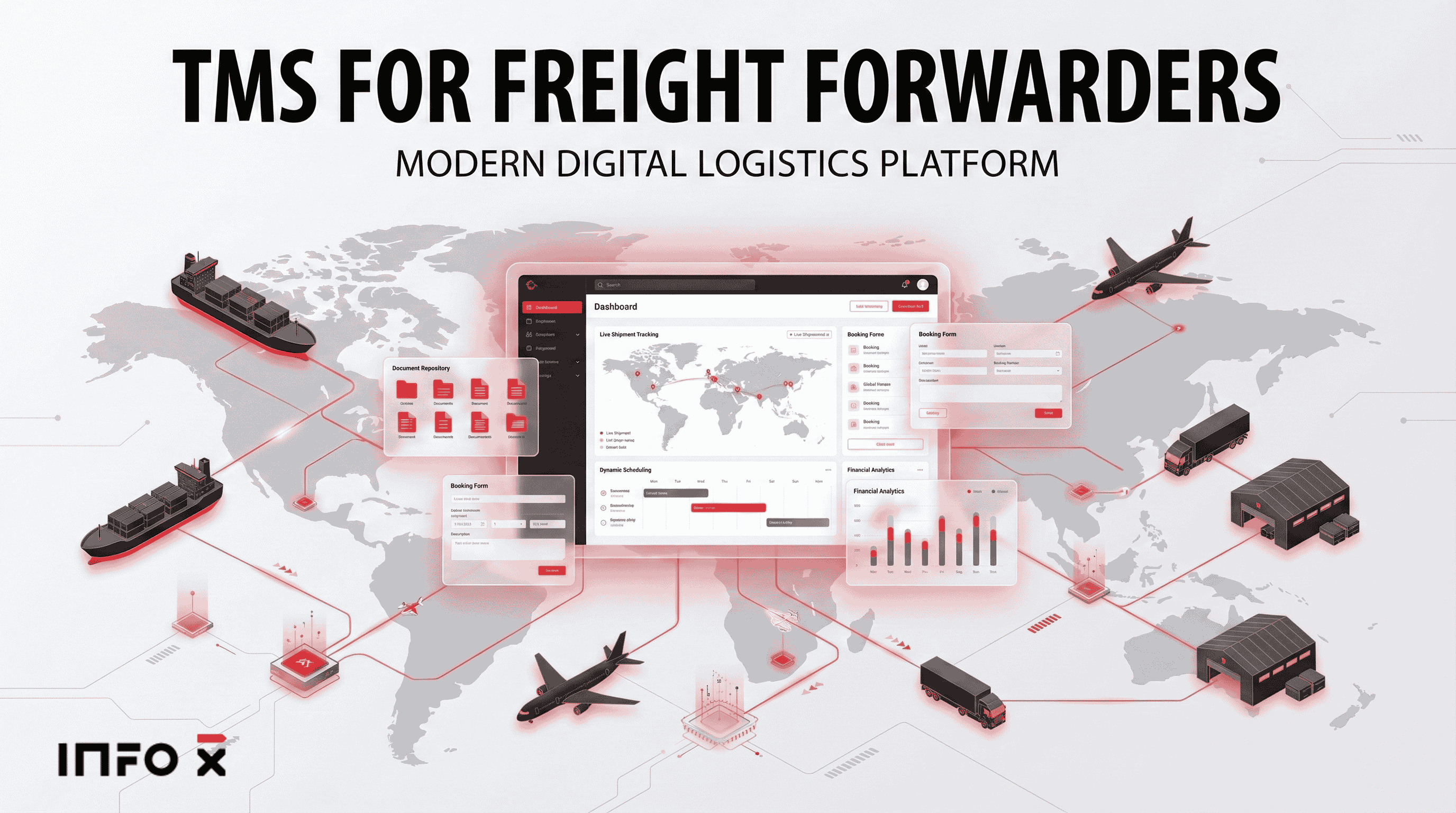
Freight forwarding has shifted from being a paper-heavy coordination task to a digitally driven execution business. Shippers expect instant quotes, accurate documents, real-time visibility, and proactive exceptions management. To keep up, forwarders need more than spreadsheets and email threads — they need a modern Transportation Management System (TMS) that acts as the operational backbone of their business.
This guide explains what a TMS for freight forwarders should really do, which capabilities matter, how different types of TMS platforms compare, and where a specialized digital logistics platform like Info-X TMS fits into your technology roadmap.
What Is a TMS for Freight Forwarders?
A Transportation Management System is a central operating platform that manages the full lifecycle of a shipment:
- Before shipment: rates, quoting, routing, compliance checks
- During shipment: bookings, carrier coordination, tracking, exceptions
- After shipment: documents, freight audit, invoicing, analytics
For a freight forwarder, a TMS should not just "store data." It should:
- Orchestrate workflows across sales, operations, documentation, and finance
- Connect with carriers, customs systems, customers, and partners
- Turn day-to-day execution into repeatable, trackable, and automated processes
Why Freight Forwarders Need a Modern TMS Now
Customer expectations and regulatory pressure are rising at the same time. Relying on manual workflows creates risk in four critical areas:
Every new customer or lane adds manual workload. Schedules, bookings, and status updates consume inbox time instead of value-add work.
Shippers want real-time shipment status without having to chase for updates. Forwarders that can provide portals and proactive notifications win loyalty.
Incomplete or inaccurate documents lead to holds, penalties, and delays. Regulatory requirements keep changing; static spreadsheets cannot keep up.
Revenue leakage from missed charges and incorrect billing piles up quietly. Leadership lacks a clear view of lane, customer, and branch profitability.
A modern TMS for freight forwarders addresses all four — not just with better visibility, but by reshaping how work is done across the organization.
Core Workflows a Forwarder TMS Should Cover
A serious TMS for freight forwarders should support a set of end-to-end workflows, not isolated features:
Rate management, quotes, spot bids, and customer-specific pricing rules.
Bookings with carriers, space confirmations, schedules, and milestones.
Bills of lading, manifests, shipping instructions, commercial documents, and integrations to customs filing tools.
Real-time status, automated milestone updates, and exception alerts.
Cost capture, freight audit, margin control, invoicing, and GL posting.
Self-service portals, shipment history, documentation access, and KPI dashboards.
A TMS that brings these workflows into one connected digital logistics platform gives you a structural advantage over competitors operating in silos.
Non-Negotiable Capabilities in a Modern TMS for Freight Forwarders
To choose wisely, it helps to think in capabilities, not just feature checklists. Below are the non-negotiable areas your next TMS should cover.
1. Quoting, Rates, and Margin Control
A TMS should make it easy to:
- Store, search, and compare carrier, NVOCC, and co-loader rates
- Create accurate quotes in minutes instead of hours
- Apply customer-specific margins and commercial rules
- Track quote win/loss outcomes across lanes and customers
This is where a modern TMS platform moves beyond data storage and becomes a revenue protection tool.
2. Multimodal Planning and Scheduling
Your TMS must support:
- Ocean (FCL/LCL), air, truck, rail, and intermodal moves
- Routing via transshipment hubs and gateways
- Cut-offs, sailing schedules, and flight schedules
- Support for consolidations and deconsolidations
Without multimodal planning, a forwarder TMS is just a glorified tracking board.
3. Real-Time Tracking and Exception Management
Modern shippers expect live updates, not "We'll get back to you."
Your TMS should:
- Pull status updates from carriers, portals, or integrated sources
- Present shipment milestones on a unified timeline
- Trigger alerts when events deviate from the plan
- Power customer-facing portals so clients can track shipments themselves
This moves your team from reactive firefighting to proactive exception management.
4. Digital Documents and Compliance Support
Freight forwarding is document-heavy by design. A TMS should:
- Generate and store core transport documents digitally
- Attach commercial and regulatory documents to shipments
- Support workflows around export/import documentation
- Integrate or connect easily with customs filing and compliance tools
You want a system that reduces rekeying, prevents missing data, and provides a digital audit trail for every shipment.
5. Finance, Freight Audit, and Profitability Insights
A forwarder TMS must close the loop between operations and finance:
- Capture all costs and charges associated with each shipment
- Match vendor invoices to expected costs (freight audit)
- Create accurate customer invoices with minimal manual intervention
- Feed data to your accounting or ERP system
- Report on margins by lane, customer, branch, or trade
This is where leadership gets visibility into which parts of the business are truly profitable.
6. Automation and AI-Driven Workflows
Automation is no longer a "nice to have." A modern TMS should:
- Eliminate repetitive data entry wherever possible
- Auto-populate fields from templates and master data
- Trigger workflows based on events (e.g., booking confirmed, vessel departed, POD received)
- Use analytics or AI models to highlight anomalies, risks, or opportunities
The value is not "AI for AI's sake," but removing manual effort from repeatable work so your team can focus on customers and exceptions.
7. Integration and Ecosystem Connectivity
No TMS exists in isolation. Your platform should:
- Connect securely with carriers, NVOCCs, and partner systems
- Integrate with accounting, ERP, or BI tools
- Exchange data with customs, visibility tools, and other digital platforms
- Offer APIs and standard formats so your stack can evolve over time
A TMS that integrates well becomes the spine of your digital logistics ecosystem.
8. Customer Portals — The Most Overlooked Differentiator in Modern TMS Platforms
A major gap in legacy logistics systems is the absence of a dedicated customer-facing portal. For today's shippers and consignees, "send me an update" is no longer acceptable — they expect instant, self-service access to everything related to their shipments.
A modern TMS for freight forwarders should include a fully secure customer portal that enables:
Customers should be able to track all active and previous shipments in a single dashboard, view milestones, ETAs, exceptions, and carrier status updates in real time. No more manual check-ins, forwarded emails, or PDF reports.
A portal should give customers direct access to bills of lading, commercial invoices, packing lists, delivery orders, and customs and compliance records. Document access should be downloadable, timestamped, and searchable.
A modern customer portal should proactively notify customers when cargo departs/arrives, cut-offs are approaching, documents are missing, or delays or holds occur. Instead of forwarders chasing exceptions, the system drives proactive communication.
A TMS with a customer portal should support cost visibility and quote confirmations, invoice downloads and aging status, and POD access and financial reconciliation. This reduces disputes and accelerates the billing cycle.
The best portals support controlled, audit-ready communication: comments and instructions tied to specific shipments, time-stamped conversation logs, and action visibility across customer teams, not just one user. This creates a single source of truth and eliminates email friction.
Comparing Different Types of TMS Options for Forwarders
Not every forwarder needs the same type of system on Day 1. Broadly, you will encounter three categories:
1. Entry-Level or "Starter" TMS
- Built for small teams and simple workflows
- Covers basic bookings and status tracking
- May lack deep documentation, finance, or multimodal capabilities
Good for: Very small forwarders just leaving spreadsheets; teams needing a quick starting point without a full transformation.
Risk: You can quickly outgrow the system and face a second migration.
2. Generic Supply Chain or Logistics TMS
- Designed to work across manufacturers, distributors, and 3PLs
- Often strong in domestic distribution or truck routing
- Less opinionated about forwarding-specific workflows
Good for: Organizations with a mixed logistics profile; simple import/export plus strong domestic flows.
Risk: You end up adapting your forwarding workflows to a tool that was never designed for them.
3. Specialized TMS for Freight Forwarders
- Built around forwarder, NVOCC, and consolidator workflows
- Handles multimodal, international, and document-heavy moves
- Connects quoting, execution, documentation, and finance into one system
- Supports automation and analytics tailored to forwarding
Good for: Forwarders who want to digitize the entire shipment lifecycle; organizations planning to scale without multiplying back-office headcount.
How to Evaluate TMS Platforms: Practical Checklist
When you're shortlisting TMS systems, use questions that reveal fit for your specific business, not just demo polish:
Can the platform map accurately to how you quote, book, document, and invoice today?
Will it still make sense when your shipment volume doubles? Can it handle additional trade lanes, modes, or branches?
How long will it realistically take to go live? How much of your process needs to change to fit the system?
Does it connect with your accounting, visibility, or customs systems?
Which steps become automated on Day 1? How does the system help you see performance, not just process shipments?
Does the provider deeply understand forwarding and NVOCC operations, or are they generalists?
When you compare systems using these questions, the right choice usually becomes very clear.
Conclusion
The right TMS for freight forwarders is not just a visibility tool. It is the system that:
- Unifies quoting, execution, documentation, and finance
- Reduces manual effort across every shipment
- Gives leadership clear insight into performance and profitability
- Improves the experience for shippers who expect modern digital logistics
Whether you are replacing legacy tools or moving beyond spreadsheets, the next decision you make about your TMS will define how scalable your forwarding business is over the next decade.
A specialized digital logistics platform like Info-X TMS connects all these workflows in one system, helping forwarders eliminate manual back-office work, improve visibility, and scale operations without increasing staff.
FAQs
The main benefit is end-to-end control over the shipment lifecycle — from quoting and booking to documentation, tracking, and invoicing — in one connected system instead of multiple disconnected tools.
Yes. In fact, smaller forwarders often gain the most because a TMS helps them compete with larger players by offering professional visibility, automation, and accuracy without adding large teams.
Forwarder-focused platforms are designed around international, multimodal, and document-heavy workflows. Generic tools may handle domestic transport well but struggle with complex forwarding scenarios.
Customers get consistent updates, self-service visibility, and faster access to documents and invoices. This reduces friction, improves trust, and makes it easier for them to keep shipping with you.
Start by mapping your core workflows and pain points. Then look for a forwarder-centric TMS that can digitize those workflows with minimal disruption. Reviewing a specialized platform like the Info-X TMS for freight forwarders is a practical first step.
Transform Your Freight Forwarding Operations with Info-X TMS
Unify quoting, booking, tracking, documents, customs, finance and automation in one modern digital logistics platform. Eliminate manual back-office work, improve visibility and scale operations without increasing staff.
Explore the Info-X TMS platform today.