
For NVOCCs managing UAE-bound consolidations, the House Bill of Lading is not merely a shipping document. Under the UAE's Maritime Pre-Load Cargo Information programme, every HBL represents a discrete filing obligation that must be submitted and accepted by NAIC before the vessel is permitted to load at the last foreign port. A single field error in a single HBL can block an entire container from sailing, regardless of how many other consignments in that box are perfectly compliant.
That is the operational reality that makes HBL data accuracy a mission-critical function rather than a documentation formality. NAIC's automated screening system validates each submission against a defined set of data requirements, and it does not distinguish between an innocent typo and a structural data error. Both produce the same outcome: a status that prevents loading until the issue is corrected and a clean acceptance is received.
This checklist breaks down every HBL data field that NAIC requires, explains what the acceptance standard is for each, identifies the specific error patterns that produce the most common rejections, and sets out the timing discipline NVOCCs must build into their UAE trade lane workflows to ensure cut-off compliance is structural rather than situational.
Why the HBL Level Is the NVOCC's Responsibility
The MPCI framework operates across two filing levels. Ocean carriers file the Master Bill of Lading level submission, covering the vessel, voyage, and the overall container movement. NVOCCs and freight forwarders are responsible for the House Bill of Lading level filing, covering each individual consignment within the container. NAIC requires both to be accepted before loading is authorised, and it cross-references the two levels automatically to verify that the data is consistent.
This means the NVOCC's HBL submission carries a dual burden. It must satisfy NAIC's standalone data requirements for the HBL level, and it must also align with whatever the carrier has filed at the MBL level. Discrepancies between the two, whether in vessel identification, container number, or party references, are flagged as cross-level mismatches that require resolution before loading proceeds.
For NVOCCs operating LCL consolidations across multiple origins, the practical implication is significant. A container with twelve HBLs from eight different shipper locations across three countries requires twelve individual MPCI submissions, each meeting the same data standard, each consistent with the carrier's MBL, and each cleared before the single terminal cut-off that applies to the entire box. There is no mechanism for partial clearance. NAIC's loading authorisation is all-or-nothing at the container level.
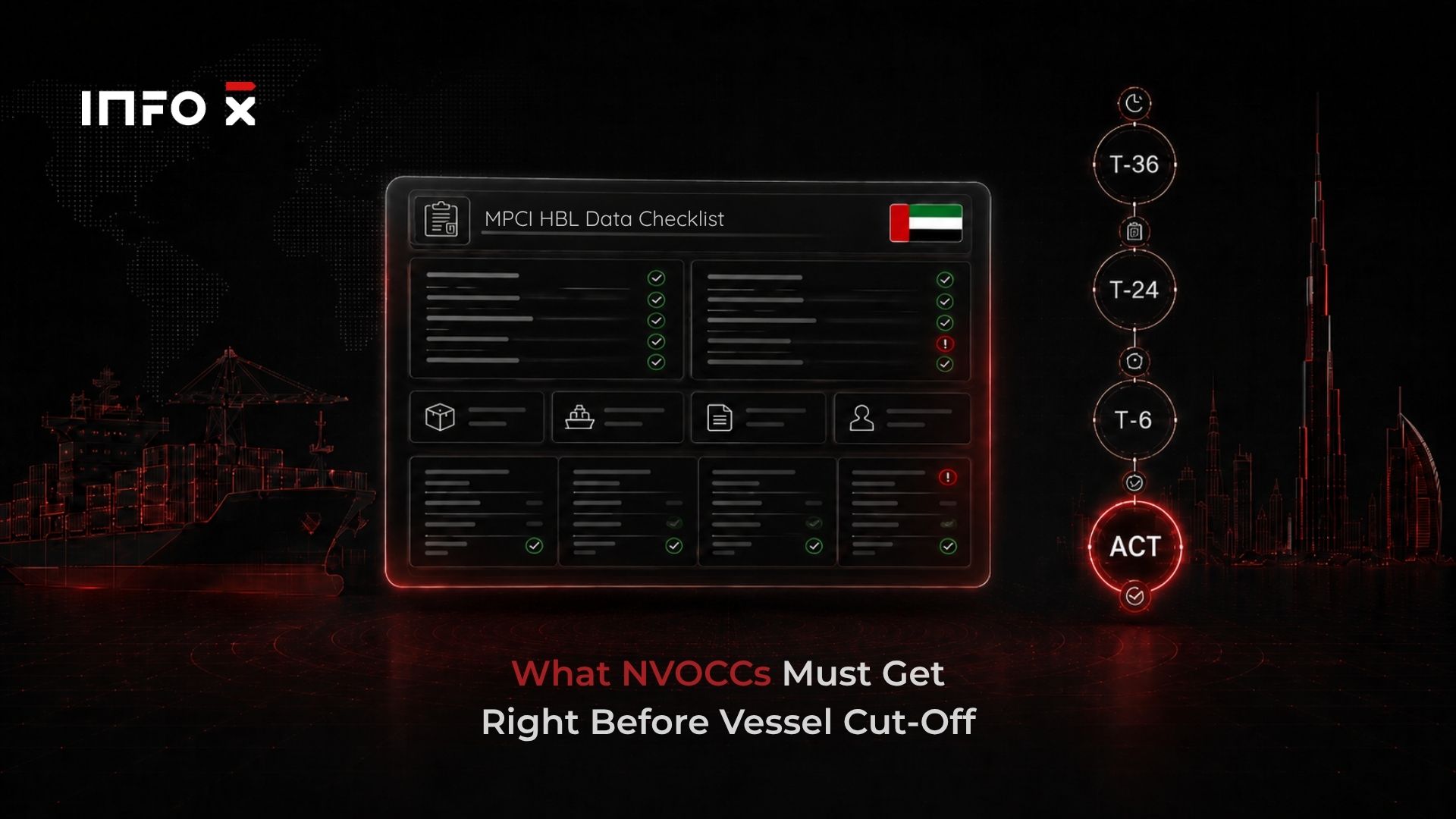
The HBL data checklist below reflects the complete set of fields validated by NAIC's automated system. Each item represents a specific rejection trigger when missing or inaccurate. Work through every field for every HBL before submitting.
The MPCI HBL Data Checklist: All Required Fields
The following checklist covers every data element NAIC validates at the House Bill of Lading level. Each section identifies what is required, what the acceptance standard is, and what the most common failure mode looks like in practice.
1 Shipper Identification
-
Full Legal Name of Shipper The shipper must be identified by their registered legal entity name, not a trading name, abbreviation, or informal reference. NAIC cross-references party names against commercial documentation. A trading company listed instead of the legal manufacturer or exporting entity is a common rejection trigger.
-
Complete Street Address Street name, building number, city, postal code, and country are all mandatory. PO Box entries alone are not accepted. Missing postal codes are one of the highest-frequency rejection causes across MPCI filings globally.
-
Country of Origin Must match the country of the shipper address and be consistent with the declared routing of the consignment. Mismatches between shipper country and declared port of loading raise automated flags.
2 Consignee Identification
-
Full Legal Name of Consignee Same standard as the shipper. The consignee must be identified by legal entity name. "To Order" entries and simplified consignee designations that may be acceptable on the commercial invoice are not acceptable in the MPCI data structure.
-
Complete Consignee Address Including Postal Code Full structured address is required. The UAE address of the consignee must include the emirate, street or area designation, and postal code where available. Partial addresses consistently generate RFI status responses from NAIC.
-
Notify Party Details (Where Applicable) Where a notify party is designated on the HBL and differs from the consignee, that party's full name and address must also be included in the MPCI submission. Omitting notify party data when it appears on the HBL creates a document-to-filing mismatch.
3 Cargo Description
-
Specific, Non-Generic Commodity Description This is the single most common rejection trigger across all MPCI filings. NAIC's system cannot complete an automated risk assessment on a shipment described as "general cargo," "merchandise," "parts," "goods," "mixed cargo," or any similarly vague term. The description must name the actual commodity: what the product is, what material it is made from, and in most cases what it is used for. "Polypropylene injection-moulded automotive brackets" passes. "Plastic parts" does not.
-
HS Code at the Required Digit Level The Harmonized System code must accurately classify the commodity and must be consistent with the written description. The minimum accepted digit level is HS6. Many commodity categories require the full HS8 or HS10 classification. Using an HS code that broadly covers a category when a more specific code exists, or using an outdated code from a prior HS edition, both generate validation failures. The HS code and cargo description must tell the same story about the same product.
-
Consistency Between Description and HS Code NAIC's validation engine cross-checks the written description against the declared HS code. A shipment described as "fresh fruit" with an HS code from the industrial machinery chapter fails this cross-check immediately. Errors of this type most commonly occur when HS codes are copied from prior shipments without being reviewed against the actual cargo on the current booking.
4 Quantity and Weight
-
Package Count and Package Type The number of packages and the package type, such as cartons, pallets, drums, or rolls, must be stated and must match the packing list. Discrepancies between the MPCI submission and physical cargo documentation create integrity flags.
-
Gross Weight in Kilograms Gross weight must be declared in kilograms and must be consistent across the MPCI filing, the commercial invoice, and the packing list. Significant weight discrepancies between the MPCI and the physical manifest are treated as data integrity failures and can trigger examination requests at the UAE port of discharge even after loading has been authorised.
-
Volume or Measurement (Where Required) For cargo categories where volumetric measurement is a standard commercial data point, including break-bulk, project cargo, and certain bulk commodities, volume in cubic metres should be included to ensure completeness of the submission.
5 Container and Equipment Data
-
Container Number The ISO container number must be accurate, complete, and consistent with the carrier's manifest. Container numbers follow a defined format: four-letter prefix, six-digit serial number, and one check digit. An incorrectly transcribed container number breaks the correlation between the HBL filing and the MBL data, triggering a cross-level mismatch that requires manual resolution.
-
Seal Number The seal number applied to the container at origin must match what the carrier holds on their manifest. Late changes to seal numbers at the terminal, which happen when a container is reinspected or resealed, require immediate amendment to the MPCI submission before the filing status becomes invalid at loading.
-
Container Size and Type The equipment type, such as 20GP, 40HC, 40RF, or 45HC, must be correctly stated and consistent with the carrier's booking confirmation. Equipment type mismatches between the HBL and MBL level submissions generate automated cross-reference flags.
6 Transport and Routing Data
-
Vessel Name and Voyage Number Both must match the carrier's MBL exactly, including spelling, vessel prefix, and voyage suffix format. A vessel name entered as "MSC AURORA" when the carrier's manifest uses "MSC AURORA V" creates a non-matching reference that NAIC's cross-check identifies as an inconsistency.
-
Port of Loading The port where the container is loaded onto the vessel must be accurate. For transhipment moves, this is the last foreign port of loading, not the origin port of the cargo. Confusing origin port with port of loading is a frequent error on transhipment bookings.
-
Port of Discharge The UAE port where the container will be discharged must be correctly stated. Jebel Ali, Port of Sharjah, and Abu Dhabi ports have distinct NAIC port codes. Using the wrong port code for the cargo's actual destination is a common entry error that requires amendment.
-
Transhipment Port (Where Applicable) For cargo that moves through an intermediate transhipment port before the final UAE destination, the transhipment port must be declared in the routing data. Omitting transhipment port information when the cargo's routing includes a feeder connection is a filing incompleteness that NAIC flags.
7 Bill of Lading References
-
House Bill of Lading Number The HBL number in the MPCI submission must exactly match the HBL number on the physical document issued to the shipper. Even a single character difference, including trailing spaces, leading zeros, or delimiter variations, creates a document-to-filing mismatch that breaks the audit trail NAIC requires.
-
Master Bill of Lading Reference The MBL number issued by the ocean carrier must be correctly referenced in the HBL MPCI submission. This is the cross-reference that allows NAIC to link the HBL and MBL filings together and verify data consistency between them. An incorrect MBL reference means NAIC cannot complete this cross-check and will hold the filing in a pending or RFI status.
-
Cargo Movement Type The filing must correctly identify the movement category: import, transhipment, transit, or FROB (Freight Remaining On Board). Using the wrong movement type causes the submission to be assessed under incorrect compliance criteria and generates a validation error that requires amendment before acceptance.
The Six Error Patterns That Most Frequently Stop Containers
Across MPCI filings on UAE trade lanes, certain data errors appear with far higher frequency than others. Understanding these patterns allows NVOCCs to build pre-submission checks that target the most likely failure points first, which is particularly important when working against a tight vessel cut-off window.
Generic Description
Using "general cargo," "parts," or "merchandise" as the commodity description. NAIC's automated system cannot risk-classify these entries and returns a validation rejection immediately.
Mismatched HS Code
The HS code copied from a prior shipment without verification against the current cargo, or an outdated code from a previous HS edition, that does not match the written description.
Incomplete Address
Missing postal code, missing street detail, or a PO Box used as the complete address for either shipper or consignee. Partial addresses are among the highest-volume rejection causes.
Container Number Error
A single transposed digit in the container number breaks the MBL-HBL cross-reference. This type of error typically only surfaces when NAIC returns a cross-level mismatch flag close to cut-off.
Wrong MBL Reference
HBL submission references an incorrect or outdated MBL number. Occurs most frequently when booking references are updated by the carrier after the initial filing has already been started.
Late Seal Amendment
The container is reinspected or resealed at the terminal after the MPCI filing. The filing reflects the original seal number, creating a mismatch with the carrier manifest at the time of loading.
The Cut-Off Timing Window NVOCCs Must Build Around
Understanding the MPCI data requirements is only one part of the compliance challenge. The other is timing. NAIC's validation process is not instantaneous, and the gap between submission and a clean ACT status can span several hours when RFI responses are required. NVOCCs who submit MPCI filings at the last possible moment before vessel cut-off have no buffer for amendment cycles.
The practical operational standard for MPCI submissions on UAE trade lanes is to have all HBL filings submitted and ideally at ACT or ACW status at least 24 to 36 hours before the terminal cut-off at the loading port. This timeline accounts for NAIC's processing window, one full amendment cycle if an RFI is returned, and the time required to source corrected data from shippers across different time zones.
-
T-3636 Hours Before Vessel Cut-Off: Submit All HBL Filings All HBL MPCI submissions should be transmitted to NAIC by this point. Any submission made after this window risks running out of time to complete an amendment cycle if NAIC returns an RFI.
-
T-2424 Hours Before Cut-Off: Verify All NAIC Statuses Confirm that every HBL filing has received ACT or ACW status. Any filing still showing Pending, RFI, or DNL at this point requires immediate escalation. An RFI response submitted at T-24 has a reasonable probability of achieving ACT status before cut-off. An RFI discovered at T-2 almost certainly does not.
-
T-66 Hours Before Cut-Off: Final Status Check and Carrier Coordination Confirm final statuses and align with the carrier on any outstanding MBL-HBL cross-reference items. If any HBL is still not at ACT, begin the operational process for managing a potential container hold, including shipper notification and alternative vessel assessment.
-
ACTAll HBLs at ACT or ACW: Vessel Loading Authorised Once all HBL filings have achieved ACT (Accepted) or ACW (Accepted with Warning) status and the MBL submission from the carrier is also accepted, the container is cleared for loading. The ACW status requires monitoring to confirm no amendment is subsequently required by NAIC.
For LCL consolidations specifically: A single unresolved HBL at the cut-off blocks the container for all consignees. There is no mechanism to release the container partially or to sail with a subset of cleared HBLs while leaving the non-compliant consignment behind. The entire container waits.
Why Pre-Submission Validation Changes the Outcome
The error patterns described above are not difficult to prevent individually. A generic cargo description can be fixed in thirty seconds once it is identified as a problem. A missing postal code takes under a minute to correct if the address data is available. The challenge is not the complexity of the fix. It is the timing of discovery.
When data errors are identified by NAIC's system after submission, the NVOCC is operating under time pressure, coordinating across time zones, chasing shippers or origin agents for corrected information, and managing carrier communications simultaneously. The same error that takes thirty seconds to correct at booking stage can take three hours to resolve at cut-off stage simply because the people and systems involved are not immediately available.
Pre-submission validation that checks every HBL field against MPCI requirements before transmission to NAIC removes this class of problem entirely. Errors caught at the validation stage, before NAIC has seen the filing, cost nothing. Errors caught by NAIC's system cost the time and commercial exposure of an amendment cycle under pressure. For NVOCCs running high volumes of UAE trade lane bookings, the compounding benefit of consistently clean first-pass acceptance rates is significant. Each avoided RFI cycle represents compliance team capacity returned to operational work rather than amendment administration.
Zero DNL Rejections on Every UAE Sailing
Info-X validates every MPCI HBL submission against this complete checklist before it reaches NAIC, combining automated data checking with 24x7 compliance specialists who monitor status and resolve RFIs before cut-off.
Start Your MPCI Compliance PlanHow Info-X Applies This Checklist to Every HBL Submission
Info-X has been supporting UAE MPCI filing for NVOCCs and freight forwarders since the programme's go-live date, building the platform and operational workflows that allow high-volume consolidation operators to maintain clean first-pass acceptance rates without dedicating disproportionate internal compliance resources to status monitoring and amendment cycles.
Every HBL submission processed through Info-X passes through a two-layer validation process before it is transmitted to NAIC. The first layer is automated and runs each data field against the requirements covered in this checklist: HS code format and classification logic, cargo description specificity standards, party address completeness including postal code presence, container number format validation, MBL-HBL reference alignment, and voyage information consistency. Filings that clear automated validation without exceptions are transmitted immediately, with NAIC status monitoring tracking each filing through to ACT confirmation.
The second layer involves experienced MPCI compliance specialists who review filings that automated validation flags as requiring human judgment. These are typically filings involving commodity classifications with narrow HS code boundaries, unusual routing configurations, or consignee address structures that vary by emirate-specific convention. The specialists resolve these cases using the same operational knowledge that comes from managing thousands of UAE trade lane filings across diverse cargo categories and origin markets.
For NVOCCs who want to understand how the full compliance workflow is structured, including the three filing models available from portal self-filing through to fully managed back-office outsourcing, the operational breakdown of how NVOCCs stay compliant with UAE MPCI requirements covers each model in detail along with the NAIC status monitoring process that keeps cut-off windows protected.
For compliance teams managing multiple filing obligations simultaneously, the HBL data that populates an MPCI submission originates from the same commercial documentation that feeds other customs filing programmes. When MPCI data is managed through the same platform that handles ISF, AMS, and ICS2 filings, the data consistency requirements across all programmes are enforced from a single source rather than being managed separately in each vendor's system. Teams currently using multiple vendors for different customs obligations and looking to consolidate that operation can find the operational and compliance case for that consolidation laid out in the context of why managing all customs filings through one partner produces better compliance outcomes than a fragmented vendor setup.
Conclusion
The MPCI HBL data requirements are not ambiguous. NAIC publishes what it needs, and the automated system applies those requirements consistently to every submission. The compliance challenge for NVOCCs is not understanding what is required. It is building the data collection, validation, and submission workflows that make meeting those requirements systematic rather than dependent on individual attention on each filing.
NVOCCs who work through this checklist against their current data collection practices will typically identify two or three recurring gaps that account for the majority of their RFI and rejection history. Addressing those gaps at the data collection stage, before files reach the MPCI submission stage, eliminates the cut-off exposure that those gaps currently create.
For NVOCCs who want validation built into the submission process itself rather than relying entirely on internal discipline, a specialist filing partner that applies these checks to every HBL before NAIC sees the data provides the structural compliance safety net that high-volume UAE trade lane operations require.