
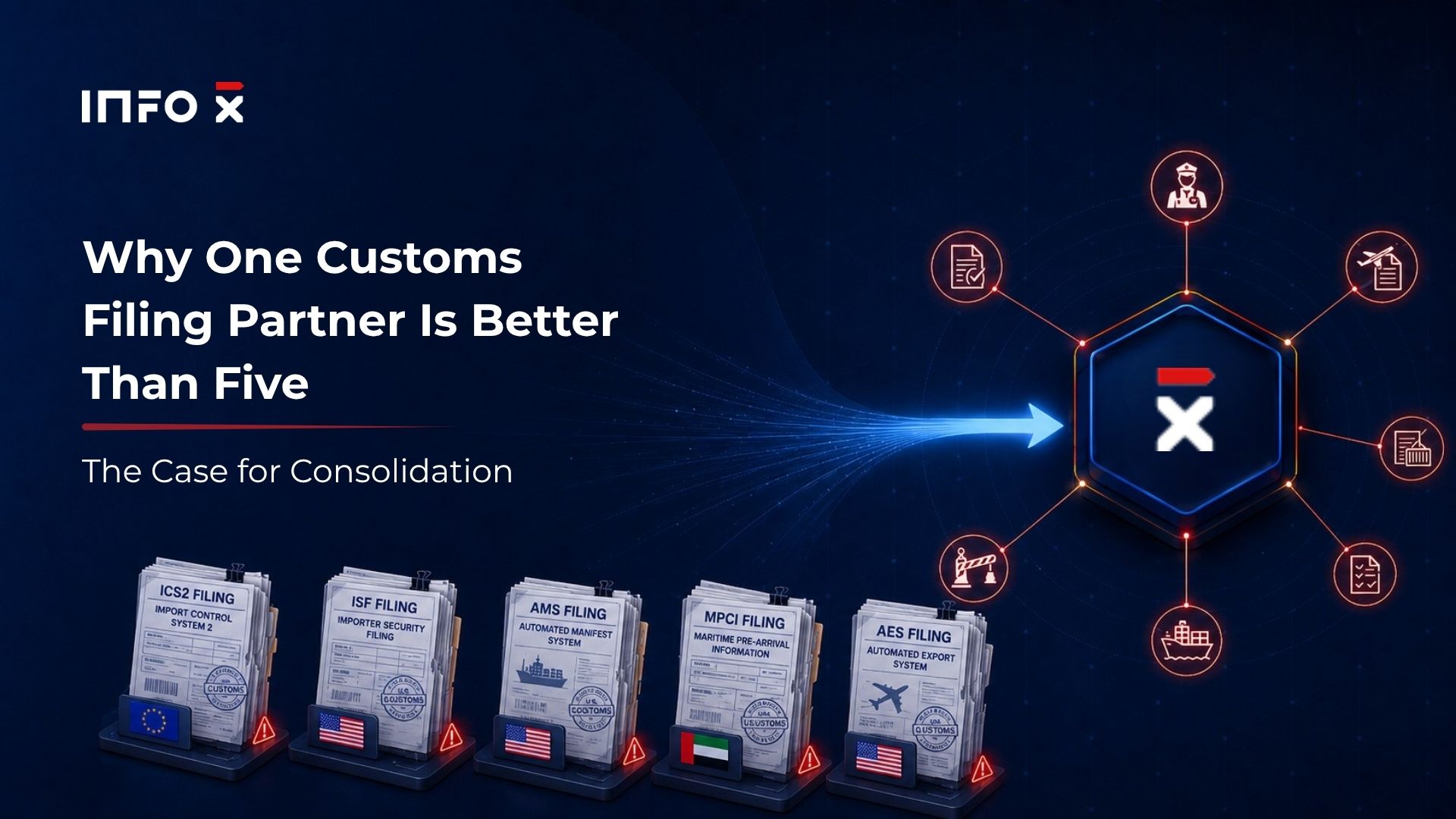
Walk through the compliance setup of most mid-size freight forwarders and you will find the same pattern: a US compliance specialist handling ISF and AMS, a separate export filing tool for AES, a third-party ICS2 filing service added when EU regulations tightened, and now a new MPCI vendor brought on for UAE trade lanes. Each addition was logical in isolation. Each solved a specific problem at a specific moment in time.
The problem is not any individual vendor. The problem is the architecture. Running five separate compliance workflows for what is, operationally, a single shipment journey creates a set of structural vulnerabilities that most freight operators do not see clearly until an enforcement action or a cargo hold makes them visible.
This article makes the case for consolidation: why a single customs filing partner covering all major programmes outperforms a fragmented multi-vendor setup on every dimension that matters operationally, including data accuracy, audit readiness, response speed under pressure, and the operational capacity that compliance teams have for actual freight work rather than vendor coordination.
How Customs Filing Fragmentation Happens
No freight forwarder sets out to build a fragmented compliance infrastructure. Fragmentation happens incrementally, one regulatory mandate at a time. ISF was the first major pre-arrival filing requirement for US-bound ocean cargo. When it was introduced, forwarders found the nearest vendor or built an internal capability to handle it. Then AMS became mandatory, then AES for export lanes. Then the EU introduced ICS2, requiring ENS submissions before EU-bound cargo loaded. Then the UAE introduced MPCI with its pre-load enforcement model. Japan has its AFR filing requirement.
Each new programme arrived with urgency. Each was adopted quickly. The result, for most forwarders operating across three or more trade corridors, is a patchwork of vendors, tools, and internal processes that were never designed to work together, because they were never designed at all. They accumulated.
The consequences of this accumulation are not always visible in day-to-day operations. They tend to surface at the worst possible moments: when a vessel cut-off is two hours away and three different vendor portals need to be logged into to investigate a status issue, or when a customs audit requests a comprehensive filing history and the documentation is scattered across five different systems with five different audit formats.
Info-X covers ISF, AMS, AES, ICS2, MPCI, and AFR from a single platform. One data source. One compliance team. One audit trail. One point of accountability across every corridor you operate.
The Data Consistency Problem That Multi-Vendor Setups Cannot Solve
The deepest structural problem with a fragmented filing architecture is not operational inconvenience. It is data consistency. Global customs authorities are not operating in isolation. They cross-reference the data submitted across different filing programmes, and they do it automatically.
US Customs and Border Protection cross-references ISF data submitted by the importer or their filing agent against the AMS manifest submitted by the carrier or NVOCC. When the same shipment is described differently across these two filings because they were prepared by different teams using different data sources, the automated targeting system flags the discrepancy. The result can be an exam request, a penalty notice, or a cargo hold at the US port of discharge.
NAIC cross-references MPCI HBL data submitted by the NVOCC or forwarder against the MBL data submitted by the carrier. EU customs cross-references ENS data across carrier and forwarder submissions. The principle is the same across every major customs programme: data submitted by one party must align with data submitted by another party for the same physical shipment.
When those two parties are using the same base data source, managed by the same filing partner, consistency is structural. When they are using different vendors who each entered data independently based on whatever documents they received, inconsistency is structural instead. The probability of a cross-filing discrepancy triggering an automated flag does not stay flat as shipment volume grows. It compounds with every consignment.
Cross-Filing Risk: A cargo description that reads "plastic components" in the ISF and "synthetic polymer parts" in the AMS manifest is technically describing the same commodity. US CBP's automated system treats these as a potential data integrity mismatch and elevates the shipment's risk score, even though no regulatory violation was intended. This type of error is nearly impossible to prevent systematically when two different vendors are filing from two different documents.
Coordination Failures Under Time Pressure
Customs compliance has deadlines measured in hours, not days. The ISF must be submitted 24 hours before vessel loading. AMS must be filed 24 hours before US port arrival. MPCI must be cleared before loading at the last foreign port. ICS2 ENS must be accepted before vessel departure for EU-bound cargo. These windows do not flex for vendor response times.
In a multi-vendor environment, when something goes wrong close to a deadline, the operations team faces a coordination problem on top of a compliance problem. Which vendor is responsible? Who has the authority to amend the filing? What is the escalation contact for that vendor at 02:00 when the vessel loads in six hours? How long will it take them to respond, and what information do they need?
With a single filing partner managing all programmes, the same team that filed the original submission handles the amendment, has access to all the relevant shipment data, and knows the full compliance context for that consignment across every applicable filing. One call, one team, full context, immediate action.
The Escalation Time Problem in LCL Consolidations
For NVOCCs managing LCL consolidations, the coordination problem multiplies. A single container may contain consignments from multiple shippers, each with its own HBL, each filed by the NVOCC or their filing partner. If one HBL triggers an MPCI RFI or an ICS2 data query, the clock is running for the entire container, not just the affected consignment. In a fragmented setup, the NVOCC is coordinating between their operations team, the MPCI vendor, the ICS2 vendor, and potentially the carrier's AMS team, simultaneously, under time pressure, with different escalation contacts and different response SLAs. The operational risk is not additive. It is multiplicative.
Fragmented vs. Consolidated Customs Filing: What Changes
| Dimension | Multi-Vendor Setup | Single Consolidated Partner |
|---|---|---|
| Data Entry | Shipment data re-entered separately per vendor | Data entered once, populates all applicable filings |
| Cross-Filing Consistency | No guarantee; each vendor works from their own documents | Structural consistency enforced from single data source |
| Amendment Under Pressure | Multiple vendor contacts, unclear accountability | One team with full context across all programmes |
| Audit Trail | Scattered across five systems in five formats | Unified audit trail covering all programmes and filings |
| 24x7 Coverage | Variable by vendor; gaps likely across time zones | Single 24x7 team covering all corridors and cut-offs |
| Compliance Visibility | No consolidated view across all programmes | Real-time status across ISF, AMS, ICS2, MPCI, AES in one dashboard |
| Vendor Management | Five contracts, five billing cycles, five escalation paths | One relationship, one contract, one accountability structure |
| Scalability | Each new corridor adds a new vendor and new process | New corridor added within existing platform and team |
The Audit Readiness Gap That Only Becomes Visible During Enforcement
Most freight operators do not think about audit readiness until an audit is requested. When a customs authority issues a compliance review notice, the first requirement is almost always documentation: proof that required filings were submitted on time, what data was included, whether amendments were made, and when. This is straightforward to produce when all filings are managed on a single platform with a unified audit trail. It is operationally painful when five different vendor systems each need to be accessed separately, data needs to be normalized across five different formats, and the historical records of amendments and acceptance confirmations need to be reconstructed.
Beyond formal audits, the operational value of a unified audit trail shows up in routine situations: a shipper disputes that their ISF was filed on time, a carrier questions whether the MPCI HBL data it received matched the NVOCC's submission, or a customs broker needs to verify that AES filing was completed before cargo departed the US port. Each of these questions is answerable in seconds with a unified compliance record. With fragmented vendors, answering them requires pulling records from multiple systems, which takes time and introduces the possibility that the records themselves are inconsistent.
What a Genuinely Consolidated Customs Filing Partner Looks Like
The word "consolidated" is often used loosely in logistics sales materials. A partner that offers two or three filing programmes through a single interface but uses different backend systems for each is not genuinely consolidated. The test is not how many programme names appear on the service page. It is whether the same data source populates every filing, whether the same compliance team manages every programme, and whether the audit trail is unified across all programmes for every shipment.
- Single Data Entry, Multiple Filing Outputs. The platform takes shipment data once and uses it to populate all applicable filings automatically. No re-keying between programmes. No separate data entry for ISF versus AMS versus ICS2.
- Pre-Submission Validation Across All Programmes. Every filing is validated against the requirements of the applicable programme before submission. A cargo description that would trigger an ICS2 rejection should be caught by the same validation engine that checks MPCI data quality, because both programmes are managed through the same compliance infrastructure.
- Direct Authority Connectivity for Every Programme. The filing partner must have direct system connections to CBP for ISF and AMS, Census for AES, EU customs for ICS2, NAIC for MPCI, and Japan Customs for AFR. Intermediary submissions through third-party systems add latency and potential failure points that direct connections eliminate.
- 24x7 Coverage Unified Across All Corridors. Vessel cut-offs and amendment windows do not respect business hours or time zone boundaries. A consolidated partner provides a single support team available around the clock for every corridor, not separate teams with overlapping and gapped coverage schedules.
- A Single Unified Audit Trail. Every submission, every status update, every amendment, every acceptance confirmation for every programme for every shipment should be accessible in one place, in a consistent format, retrievable by shipment reference, trade lane, date range, or filing programme.
- Domain Expertise in Freight Forwarding Operations. Compliance requirements in LCL consolidations, NVOCC HBL responsibilities, time-sensitive amendment workflows, and the interaction between different filing programmes for the same physical shipment require deep operational experience in international freight, not just technical familiarity with filing data formats.
The Programmes That a Consolidated Partner Must Cover in 2026
For freight forwarders and NVOCCs operating across the major global trade corridors in 2026, a consolidated filing partner needs to cover six programmes to provide genuine multi-corridor compliance from a single platform.
ISF 10+2
US ocean import security filing. 24 hours before vessel loading at foreign port.
AMS Filing
US ocean and air import manifest filing. 24 hours before US port arrival.
AES Filing
US export Electronic Export Information. Required for regulated and high-value exports.
ICS2 / ENS
EU pre-arrival Entry Summary Declaration. Applies to all modes entering EU customs territory.
UAE MPCI
Pre-load Maritime Pre-Load Cargo Information. Required before loading at last foreign port.
AFR Filing
Japan Advance Filing Rules. Pre-arrival compliance for Japan-bound cargo.
Each of these programmes has different data requirements, different deadlines, different enforcement mechanics, and different responsible parties within the supply chain. The operational challenge of managing all six through separate vendors is not just administrative overhead. It is a structural compliance risk that grows with every shipment processed and every corridor added.
One Partner. Six Programmes. Every Corridor.
Info-X covers ISF, AMS, AES, ICS2, MPCI, and AFR from a single integrated platform with one compliance team, one data source, and one audit trail across every trade lane you operate.
Explore the Consolidated Filing PlatformHow Info-X Delivers Consolidated Customs Filing
Info-X has been providing customs filing services for freight forwarders, NVOCCs, shippers, and BCOs for over 20 years. The platform that has emerged from that experience covers all six major filing programmes from a single integrated infrastructure, with the same compliance team, the same data validation engine, and the same audit trail regardless of which programme or combination of programmes a specific shipment requires.
Shipment data enters the Info-X platform once. The system identifies which filing programmes apply to that shipment based on origin, destination, mode, and cargo type. It validates the data against each applicable programme's requirements before submission, catching errors that would cause rejections or generate customs flags. Each filing is transmitted through direct authority connectivity, and status updates are reflected in real time in the compliance dashboard for every programme simultaneously.
For NVOCCs and freight forwarders who want to understand what this approach looks like in practice for a specific corridor, the operational detail of how consolidated compliance works on UAE trade lanes is covered in the guide to how NVOCCs stay compliant with UAE MPCI filing requirements. For operators managing simultaneous US, EU, and UAE obligations from a single origin-to-destination shipment, the full landscape of how each programme interacts with the others, where enforcement timelines overlap, and where the data dependency chain creates cross-filing risk is covered in the comprehensive overview of global customs filing requirements in 2026.
The 24x7 compliance team that supports the Info-X platform manages every amendment, every RFI response, every status escalation, and every cut-off exception across all six programmes. When a vessel loading window is closing and an MPCI RFI needs a response, the same team that filed the original submission handles the amendment. When an ICS2 ENS data quality query comes back from EU customs, it is resolved by the compliance specialists who understand the data that was submitted and why. This is what genuine single-partner accountability looks like in practice.
For operators whose primary concern is a specific corridor, Info-X provides dedicated programme pages covering each filing type in full operational detail. The UAE MPCI filing service covers the NAIC compliance workflow in depth, including the three filing models available to NVOCCs: self-filing with AI validation, full back-office managed filing, and EDI/API automated integration.
Conclusion
The case for consolidating customs filings with a single partner is not primarily a case about administrative efficiency, although the efficiency gains are real and measurable. The primary case is about structural compliance integrity: the ability to guarantee data consistency across filing programmes that cross-reference each other, to respond under time pressure with a single team that has full context, and to produce a unified compliance record that satisfies audit requirements across every corridor the business operates.
Fragmented multi-vendor setups carry hidden costs that only become visible at enforcement moments. The question for most freight forwarders and NVOCCs is not whether those costs exist. It is whether they surface before or after a significant compliance incident forces the issue.
For operators ready to evaluate what a genuinely consolidated customs filing architecture looks like for their specific corridor mix, Info-X provides the platform, the domain expertise, and the compliance team to make that transition without operational disruption.