
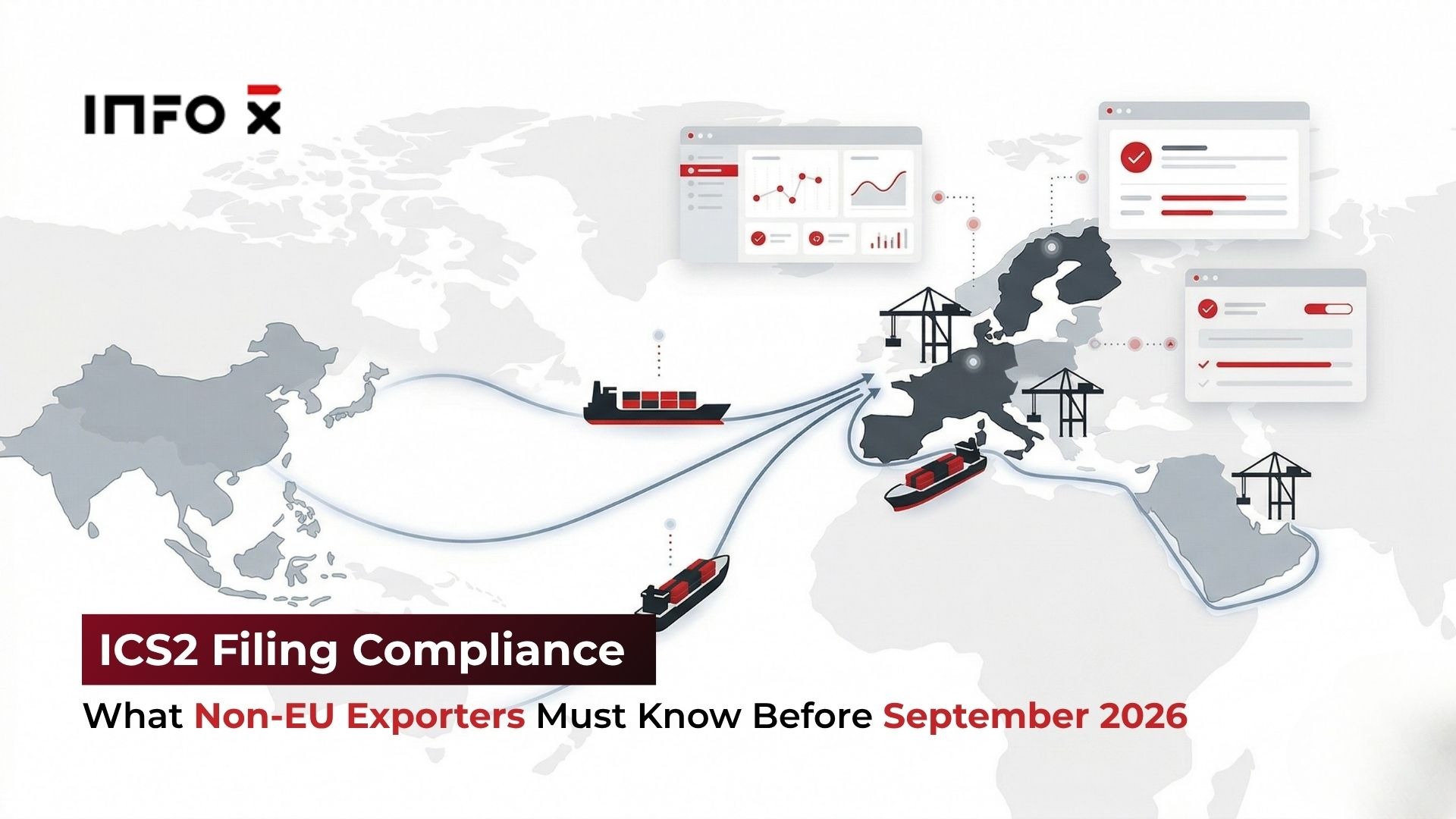
There is a practical reality that many non-EU exporters have not yet fully absorbed: ICS2 does not only affect European logistics companies. It directly affects every shipper, manufacturer, and exporter anywhere in the world who moves goods into EU customs territory. The majority of that cargo moves by ocean. Full container loads, LCL consolidations, and transhipment corridors from Asia, North America, and the Middle East into European ports are all subject to ICS2 pre-arrival ENS requirements, and the accuracy of every ENS depends entirely on the quality of the data that originates with the exporter.
When an ENS is filed late, rejected, or flagged for poor data quality, the cause is almost never a filing platform problem. It is almost always a data problem, and data problems begin upstream with the exporter's commercial documents, Bill of Lading details, commodity descriptions, and party information. This is why understanding ICS2 is not optional for non-EU exporters who want their goods to clear EU customs without delays, cargo holds, or vessel cut-off failures.
Before September 2026, EU customs authorities are further tightening automated risk analysis and data quality enforcement across all transport modes. For non-EU exporters who have treated ICS2 as their freight forwarder's administrative task, that assumption is becoming an operational liability.
What ICS2 Is, and Why It Was Built
ICS2, formally the Import Control System 2, is the European Union's advance cargo safety and security programme. Its fundamental purpose is identical to that of comparable pre-arrival programmes in the United States and UAE: risk assessment of cargo before it reaches EU customs territory, not after. The EU introduced ICS2 to replace its predecessor, the ICS framework, which regulators determined was insufficient for modern security and supply chain visibility requirements.
Under ICS2, all economic operators moving cargo into or through the EU must submit an Entry Summary Declaration containing detailed shipment data. For ocean freight, this means the ocean carrier files a master-level ENS, and the NVOCC or freight forwarder files a house-level ENS for each consolidated consignment. Both filings must be submitted and accepted before the vessel loads at the foreign port of departure. The ENS feeds into EU customs' automated risk analysis engine, which screens each consignment against risk parameters before any vessel departs.
The key architectural difference between ICS2 and legacy customs reporting is that it operates on shared filing responsibility. The carrier and the forwarder each carry their own obligations, and EU customs cross-references those filings automatically. When the data at house level does not align with the master filing, the system flags the discrepancy. This is precisely why the commercial documents a non-EU exporter provides at the point of booking determine whether every downstream ENS succeeds or fails.
Info-X is a specialist ICS2 filing company that has processed thousands of ENS submissions with a 99.9% first-pass acceptance rate, supported by direct EU Customs connectivity and a two-layer validation process combining automated checks with experienced compliance review.
The ICS2 Phased Rollout: Where Enforcement Stands in 2026
ICS2 was introduced in phases across different transport modes, with ocean freight going live in July 2024. For non-EU exporters moving goods by sea, this means the ENS obligation for their EU-bound shipments has been active for over a year. Enforcement is not new; what is changing before September 2026 is the stringency of the automated data quality checks being applied to each submission.
| Transport Mode | ICS2 Enforcement Active Since | Filing Type Required | Non-Compliance Risk Level |
|---|---|---|---|
| Ocean Freight | July 2024 | Pre-Arrival ENS (24 hrs before vessel loading) | High |
| Air Freight | November 2024 | PLACI + Pre-Arrival ENS | High |
| Road Transport | April 2025 | Pre-Arrival ENS (2 hrs before border crossing) | High |
| Rail Transport | April 2025 | Pre-Arrival ENS (2 hrs before border crossing) | High |
| All Modes (Enhanced Enforcement) | September 2026 | Stricter data quality standards apply | Critical |
By September 2026, the EU's automated risk analysis systems will apply tighter quality thresholds to every ENS submission. Data that has historically passed with minimal scrutiny, vague commodity descriptions, incomplete shipper addresses on commercial invoices, or borderline HS6 code accuracy, will increasingly trigger automated holds and requests for additional information. For non-EU exporters whose EU-bound ocean volumes are growing, the operational cost of non-compliant data compounds rapidly at scale.
Who Is Responsible for ICS2 Filing
One of the most important things for non-EU exporters to understand about ICS2 is that the legal filing obligation sits with the carrier and the freight forwarder, not with the exporter directly. For ocean freight, the ocean carrier files the master Bill of Lading level ENS. The NVOCC or freight forwarder files the house Bill of Lading level ENS for each consolidated consignment. Both must be submitted and accepted before the vessel is loaded at the port of origin. The non-EU exporter is not submitting anything to EU customs directly.
However, that distinction does not reduce the exporter's practical responsibility for compliance outcomes. Every data element that goes into the house-level ENS, from the HS6 commodity code to the full shipper and consignee address to the specific cargo description, either comes from the exporter's commercial invoice and packing list or must be verified against those documents. When an exporter provides a commercial invoice with a generic cargo description, an incomplete address, or an inaccurate commodity classification, the freight forwarder who files on their behalf is working with flawed inputs. The resulting ENS may be technically submitted on time but will fail EU customs' automated data quality review.
For NVOCCs managing consolidated ocean loads, this dependency on exporter data quality is multiplied across every HBL in the consignment. A single inaccurate house bill can trigger a customs query that affects the release of the entire container. The practical implication is that non-EU exporters need to think of ICS2 compliance as a shared operational discipline, not a task they have fully delegated once the booking is confirmed.
What the ENS Actually Requires
Understanding the specific data elements that an ICS2 Entry Summary Declaration requires is the most direct way for non-EU exporters to identify where their current documentation practices need to change. The requirements are not complex to understand, but they are rigorous in their enforcement, particularly regarding commodity description quality.
-
1
Specific Cargo Description
Generic terms such as "parts," "goods," "merchandise," "clothing," or "food items" are not accepted. EU customs requires a specific description of the actual commodity: what it is, what it is made of, and what it is used for. This is the single most common rejection trigger for ENS filings.
-
2
Accurate HS6 Commodity Codes
The six-digit Harmonized System code must correctly classify the commodity and must be consistent with the written cargo description. Mismatches between the HS code and the description are flagged automatically. Codes must be current and not deprecated classifications.
-
3
Complete Shipper and Consignee Details
Full legal name, street address, city, postal code, and country are all mandatory for both shipper and consignee. Partial addresses or missing postal codes cause systematic rejection across all EU member state customs systems.
-
4
Transport Document References
The AWB, HAWB, or Bill of Lading number that identifies the specific consignment must match exactly what the carrier has on file in their own manifest submission. Mismatches between forwarder and carrier filing create multi-party conflicts that EU customs flags for manual review.
-
5
Package Count, Gross Weight, and Units
Quantity and weight data must be accurate and consistent across all documents. Significant discrepancies between the ENS and the physical manifest are treated as data integrity failures by the automated screening system.
-
6
Routing and Transit Country Information
All countries through which the cargo transits before reaching EU customs territory must be declared. Missing transit country data prevents EU customs from completing the pre-arrival risk assessment chain.
The Six Most Common ICS2 Errors That Non-EU Exporters Cause
Based on operational experience across thousands of ENS filings, the errors that trigger rejection, DNL directives, and customs holds follow recognizable patterns. Almost all of them originate in the exporter's commercial documentation, not in the filing process itself.
Generic Descriptions
Exporter submits commercial invoice with "parts" or "mixed goods" as the cargo description. Automatic EU customs rejection at the ENS validation stage.
Wrong or Outdated HS Codes
Exporter uses an HS code that does not match the actual commodity or that was correct under a prior edition of the Harmonized System but has since been updated.
Incomplete Addresses
Shipper or consignee address is missing postal code or street detail. EU customs systems require fully structured address data for all parties.
Document Number Mismatch
The HAWB or HBL number on the forwarder's ENS does not match the carrier's master filing, creating an unresolvable multi-party conflict in EU customs' system.
Missing Transit Countries
Exporter does not disclose intermediate routing through third countries. EU customs cannot complete pre-arrival screening without full routing data.
Late Document Delivery
Exporter sends commercial invoice and packing list after the ENS filing deadline has already passed, making timely submission impossible regardless of the forwarder's efficiency.
Filing Deadlines Non-EU Exporters Must Account For
For ocean freight exporters, the 24-hour pre-loading ENS deadline is the most operationally significant timeline in the ICS2 framework. It is not a target the freight forwarder sets internally; it is a hard regulatory cut-off enforced by EU customs systems against the vessel loading schedule at the origin port. The exporter's obligation is to deliver accurate, complete commercial documentation to their forwarder far enough in advance that the ENS can be validated and transmitted before that window closes. Working backward from the vessel's cargo receipt date, the practical deadline for document delivery is typically 36 to 48 hours before the ship's cut-off, not 24 hours.
| Transport Mode | ENS Filing Deadline | What This Means for Document Delivery |
|---|---|---|
| Ocean (Deep Sea) | 24 hours before vessel loading at origin port | Exporters must deliver final commercial invoice, packing list, and accurate commodity data well before cut-off. Last-minute document delivery will result in a late filing. |
| Air (Long Haul) | PLACI before departure; pre-arrival ENS no later than time of departure | Air cargo timelines are significantly tighter. Complete shipper data must be available at the point of booking confirmation, not at the time of physical handover. |
| Air (Short Haul) | 4 hours before arrival at EU destination | Short-haul ENS windows require that exporters provide final data before the cargo departs origin, with no room for amendments during transit. |
| Road / Rail | 2 hours before arrival at EU border crossing | Road and rail exporters must ensure documentation is complete before the truck or train departs for the EU border. |
Critical Point for Non-EU Exporters: If your commercial documents reach your freight forwarder after the ENS filing window has already closed, a timely and compliant filing is impossible regardless of how capable your forwarder is. The deadline problem belongs to the exporter, not the filer.
Why Ocean Freight Exporters Face the Sharpest Compliance Pressure
Ocean freight represents the majority of EU-bound cargo by volume, and it is where ICS2 enforcement creates the most concentrated operational risk for non-EU exporters. The 24-hour pre-loading ENS deadline for deep-sea containerized shipments is a hard cut-off tied directly to vessel loading at the port of origin. EU customs' automated system does not assess the ENS after the vessel departs; it must receive and validate the submission before loading begins.
For exporters shipping FCL or participating in LCL consolidations, this timeline has a direct knock-on effect on their document delivery obligations. If an exporter sends their commercial invoice, packing list, and cargo details to their freight forwarder or NVOCC after the vessel cut-off window has closed, a compliant ENS filing is no longer possible for that sailing. The cargo either misses the vessel or sails without a valid ENS, either of which creates a compliance incident at the EU port of discharge.
NVOCCs managing LCL consolidations face a compounded version of this problem. Each HBL in the container requires its own house-level ENS. If one shipper in a consolidation delivers late or inaccurate documentation, it does not only affect their own consignment; it can create a data conflict at the master bill level that customs flags for the entire container. This is a structural risk that many non-EU exporters participating in consolidations do not fully appreciate until it affects their own delivery commitments.
Air freight carries its own pre-loading requirement called PLACI, which operates before cargo is loaded onto the aircraft at origin and can result in a loading block if the submission is deficient. The principles are the same as for ocean, but the timelines are shorter and the recovery options at an airport are more limited than at a container terminal. For operators managing both ocean and air lanes into the EU, the data quality disciplines required are identical across both modes.
Stop ICS2 Rejections Before They Stop Your Cargo
Info-X delivers 99.9% first-pass ENS acceptance with direct EU Customs connectivity, automated data validation, and experienced compliance oversight for ocean, air, road, and rail shipments into the EU.
Explore ICS2 Filing ServicesWhat Non-Compliance Actually Costs
The consequences of ICS2 non-compliance are significant enough that they warrant direct attention from exporters and their logistics partners at the planning stage, not after the first enforcement incident. The outcomes of a failed or deficient ENS filing fall into four categories, and for ocean freight operators the financial and commercial exposure is compounded by the long voyage windows that make corrections difficult once a vessel has sailed.
The most immediate operational consequence is a Do-Not-Load directive issued before the cargo is placed on the vessel. When EU customs flags an ENS submission before loading at the origin port, the carrier receives a DNL instruction. The container stays at the terminal, the booking is lost, and the shipper absorbs storage charges, a new booking fee, and the delay impact on the consignee's inventory planning. For exporters shipping into EU distribution networks on tight replenishment cycles, missing a single sailing can ripple through multiple downstream commitments.
The second category of consequence is a cargo hold at the EU port of discharge. When an ENS is submitted but contains data quality issues, EU customs may allow the vessel to depart but issue a hold instruction to the destination port. The container arrives but cannot be released until the data discrepancy is resolved. This means the consignee cannot collect the goods, demurrage and detention charges begin accumulating, and the resolution process depends on getting correct documentation submitted across time zones under commercial pressure.
Third, regulatory penalties can be assessed against the filing party for each violation. EU member states enforce penalties according to their national customs regulations, but the framework allows for fines of up to 5,000 euros per violation. Repeated non-compliance, particularly systematic data quality failures across multiple shipments from the same exporter, affects the operator's risk profile within EU customs' automated targeting system, leading to a higher proportion of containers selected for physical examination over time.
The fourth and often least quantified cost is commercial. EU buyers who repeatedly experience port holds or customs delays because their supplier's documentation is ICS2 non-compliant have a straightforward decision to make: source from a supplier whose shipping documents do not create operational disruption. For non-EU exporters competing in the EU market, ICS2 compliance is increasingly a supplier qualification criterion, not just a regulatory obligation.
How Non-EU Exporters Should Prepare Before September 2026
Preparation for the tightening ICS2 enforcement environment before September 2026 does not require non-EU exporters to build internal customs teams or develop direct EU customs connectivity. It requires a structured review of existing commercial documentation practices and a clear understanding of where the data gaps are that currently generate compliance risk for their forwarders.
- Audit your commercial invoice template for ICS2 data completeness. Confirm that cargo descriptions are specific, not generic. Replace any description that could apply to multiple commodity types with one that identifies the actual product.
- Verify that your HS6 commodity codes are current and correctly classified. Codes that were accurate under previous Harmonized System editions may have been restructured. Work with your freight forwarder to confirm code accuracy for your core product lines.
- Confirm that shipper and consignee data on your commercial documents includes full street address, postal code, city, and country for all parties. Review your address book and remove or update any incomplete records.
- Establish a document delivery timeline with your freight forwarder that accounts for the ENS filing deadline for each transport mode. Identify which shipment types are at greatest risk of late document delivery and build a buffer into your booking process.
- For ocean shipments, understand the vessel cut-off schedule and work backward from it to set an internal document delivery deadline. The ENS must be accepted by EU customs 24 hours before vessel loading, which means your freight forwarder needs complete and accurate data well before that window opens.
- Confirm that your freight forwarder is using a validated ICS2 filing platform with pre-submission data checking, not a manual process or a legacy ENS tool. The quality of the filing infrastructure your forwarder uses directly determines your exposure to automated rejection.
Why the Right ICS2 Filing Partner Changes the Outcome
Non-EU exporters who work with freight forwarders using reliable, validated ICS2 filing infrastructure will absorb the September 2026 enforcement tightening with minimal operational disruption. Those working with forwarders who manage ENS filings through manual processes or inadequate platforms will start to see the enforcement gap widen into cargo holds and penalty exposure as EU customs' automated quality checks become more rigorous.
The evaluation criteria that distinguish high-performing ICS2 filing partners from those who simply file and hope are well-established. Pre-submission validation that checks HS code accuracy, description specificity, address completeness, and multi-party data consistency before any ENS reaches EU customs is the most important capability to confirm. A platform that files whatever the forwarder provides without independent data checking shifts all the risk of data quality failures onto the customer.
Beyond ENS accuracy, the way customs filing software connects with the TMS and financial systems that a freight forwarder already operates determines whether data stays consistent across the full shipment lifecycle or introduces new inconsistencies at each handoff. Forwarders whose customs filing and TMS workflows share the same data layer file more accurately and amend less frequently than those managing ENS submissions as a separate manual process. This is a structural quality advantage that matters most when EU customs tightens its automated review thresholds.
ICS2 also sits within a broader global compliance picture. Freight forwarders managing simultaneous obligations across US import corridors, UAE trade lanes, and EU-bound ocean freight are navigating several pre-arrival filing programmes at once, each with its own deadlines and data requirements. Understanding how those programmes compare and where their enforcement logic differs is important operational context when building a multi-corridor compliance workflow.
How Info-X Approaches ICS2 Compliance
Info-X has been supporting EU customs filing requirements for freight forwarders, NVOCCs, shippers, and BCOs since long before ICS2 replaced its predecessor system. The ICS2 compliance workflow within the Info-X platform is built around the specific data structure and quality requirements that EU customs authorities enforce, not adapted from a generic customs filing template. This distinction matters most for ocean freight operators managing high-volume ENS submissions across deep-sea corridors, where even a low error rate generates significant operational exposure at scale.
Every ENS submission processed through Info-X goes through a two-layer quality assurance process. The first layer is automated: the system checks HS6 code format and accuracy, validates that cargo descriptions meet EU customs' specificity standards, confirms that shipper and consignee address data is structurally complete, and verifies that transport document references are internally consistent across both master and house bill levels. The second layer is human review by experienced ICS2 compliance staff who evaluate filings that automated validation flags as borderline or that involve unusual commodity classifications or routing configurations.
Direct connectivity to EU Customs systems means that once an ENS passes both validation layers, it is transmitted and the Movement Reference Number is returned within minutes. MRN confirmation is logged and available for audit review alongside the original filing data, the validation results, and any amendments that were subsequently made. For ocean freight forwarders managing multiple container bookings against the same vessel cut-off, this speed and reliability on each individual ENS is what keeps the full vessel manifest compliant.
Freight forwarders who also manage US-bound traffic alongside their EU ocean lanes will recognise the data discipline that operating across multiple pre-arrival filing programmes simultaneously demands. Info-X covers ISF, AMS, AES, and UAE MPCI under the same platform, which means a forwarder managing both ocean imports into the US and FCL exports into the EU is not re-entering shipment data separately for each programme.
For forwarders evaluating whether their current customs software is structurally equipped for the tighter data quality environment that September 2026 brings, the question of how customs filing software integrates with existing TMS and accounting systems is often where the real gap surfaces. When ENS data is populated from the same source as the shipment record in the TMS, the class of errors that originates in manual re-keying disappears entirely, and that is where consistent first-pass acceptance rates are built.
Operators who want to understand the specific criteria that separate reliable ICS2 filing partners from those who file without sufficient validation will find the evaluation framework for choosing an ICS2 filing company in 2026 a practical reference for shortlisting decisions. The criteria covered there map directly to the capabilities that determine whether an ENS programme delivers consistent compliance or generates recurring exceptions that cost both time and money.
Conclusion
ICS2 compliance before September 2026 is not a problem that non-EU exporters can resolve at the last minute. The data accuracy, document completeness, and process discipline that EU customs requires are built into commercial operations over time, not retrofitted the week before an enforcement deadline tightens.
Non-EU exporters who understand what ICS2 requires, who recognize that their commercial documentation is the raw material of every ENS filed on their behalf, and who work with freight forwarders using validated, accurate filing infrastructure, will move their EU-bound goods without disruption as enforcement intensifies.
Those who continue to treat ICS2 as their forwarder's administrative task without engaging in the upstream data quality practices that compliance requires will increasingly find their shipments subject to holds, delays, and the commercial consequences that EU customs non-compliance creates at scale.
The window to build the right practices is before September 2026, not after the first enforcement incident demonstrates why they matter.