Most freight forwarders, 3PLs, and importers don't set out to build fragile customs workflows.
They just add tools over time.
A TMS here may be an accounting system there, a customs filing solution that "does the job." etc.
Individually, everything works.
But then volumes increase.
Audits become stricter. Corrections become routine. And suddenly, people are spending more time reconciling data than moving freight.
That's usually when a quiet realization hits:
"Our customs filing process isn't broken; it's disconnected."
This is where choosing the right customs filing software becomes less about features and more about how well it fits into your existing operation.
Why Integration Is the Real Decision, Not the Software Itself
When companies search for customs filing software, they often focus on:
- supported filings
- country coverage
- speed of submission
Those things matter but they are table stakes.
What actually determines long-term success is this:
"Does the customs software work with your TMS and accounting system or around them?"
If it works around them, your team becomes the integration layer. And humans are expensive, inconsistent, and overworked integration layers.
What "Good Integration" Looks Like in Real Operations
Let's simplify this.
Good integration means:
- shipment data flows from your TMS without retyping
- invoice values match accounting records automatically
- customs filings reflect the same data your teams already trust
- updates don't require rework across systems
Bad integration looks like:
- spreadsheets
- CSV exports
- manual checks before every filing
- last-minute corrections
- "just double-check this one" messages
If that sounds familiar, you're not alone — but it is fixable.
The First Question You Should Ask Any Customs Software Provider
Before demos. Before pricing. Before feature lists.
Ask this:
"How does your system reduce manual data handling between operations, customs, and finance?"
If the answer is unclear, overly technical, or vague — move on.
Real integration is easy to explain and easy to see.
What to Look for When Choosing Integrated Customs Filing Software
1. Native Connection to Your TMS (Not a Workaround)
The customs software should:
- pull shipment data directly from your TMS
- understand freight structures (shipper, consignee, routing, commodities)
- update automatically when shipment details change
If your team still exports data manually, the risk hasn't gone away; it's just been shifted.
2. Financial Consistency With Accounting Systems
Customs filings rely on values, charges, and classifications. Your software should align with accounting systems so that:
- invoice values are consistent
- discrepancies are caught early
- audits don't become forensic exercises
When customs and finance disagree, trust breaks down fast.
3. One Shared Data Reality Across Teams
Operations, customs, and finance should all be looking at the same data, not their own versions of it.
Good software:
- prevents silent overrides
- tracks changes clearly
- avoids conflicting records
This isn't just efficiency — it's credibility.
4. Support for Multiple Filings From One Data Source
Growing logistics businesses don't file just one declaration.
Your customs software should support:
- ISF
- AMS
- AES
- ICS2
- MPCI
All from the same integrated dataset because when each filing type uses a different tool, errors multiply.
5. Validation That Happens Before Filing (Not After Penalties)
Integrated systems should validate:
- party roles
- commodity descriptions
- values and classifications
- consistency across filings
Validation only works when systems are connected. Otherwise, corrections happen when it's already too late.
6. Automation That Respects Human Judgment
Automation should:
- remove repetitive work
- surface issues early
- allow review when needed
Software that "auto-files everything" without context often creates more problems than it solves.
7. Clean APIs, Not Fragile Custom Builds
Integration should be:
- API-based
- scalable
- adaptable as systems evolve
Hard-coded or brittle connections become liabilities over time.
8. Clear Audit Trails Across the Full Process
When customs or internal teams ask:
"Where did this data come from?"
You should be able to answer calmly and confidently.
Good software lets you trace:
- TMS data
- customs filings
- accounting values
- changes and approvals
That's what audit readiness really means.
Common Missteps Companies Make
Even experienced teams fall into traps:
- choosing customs software in isolation
- ignoring accounting alignment until audits
- accepting exports as "integration"
- relying on brokers to fix inconsistencies
These decisions don't hurt immediately but they definitely hurt over time.
How Info-X Approaches Integrated Customs Filing
Info-X is built around one principle:
"Customs filing should be a natural extension of your operations not a separate workflow."
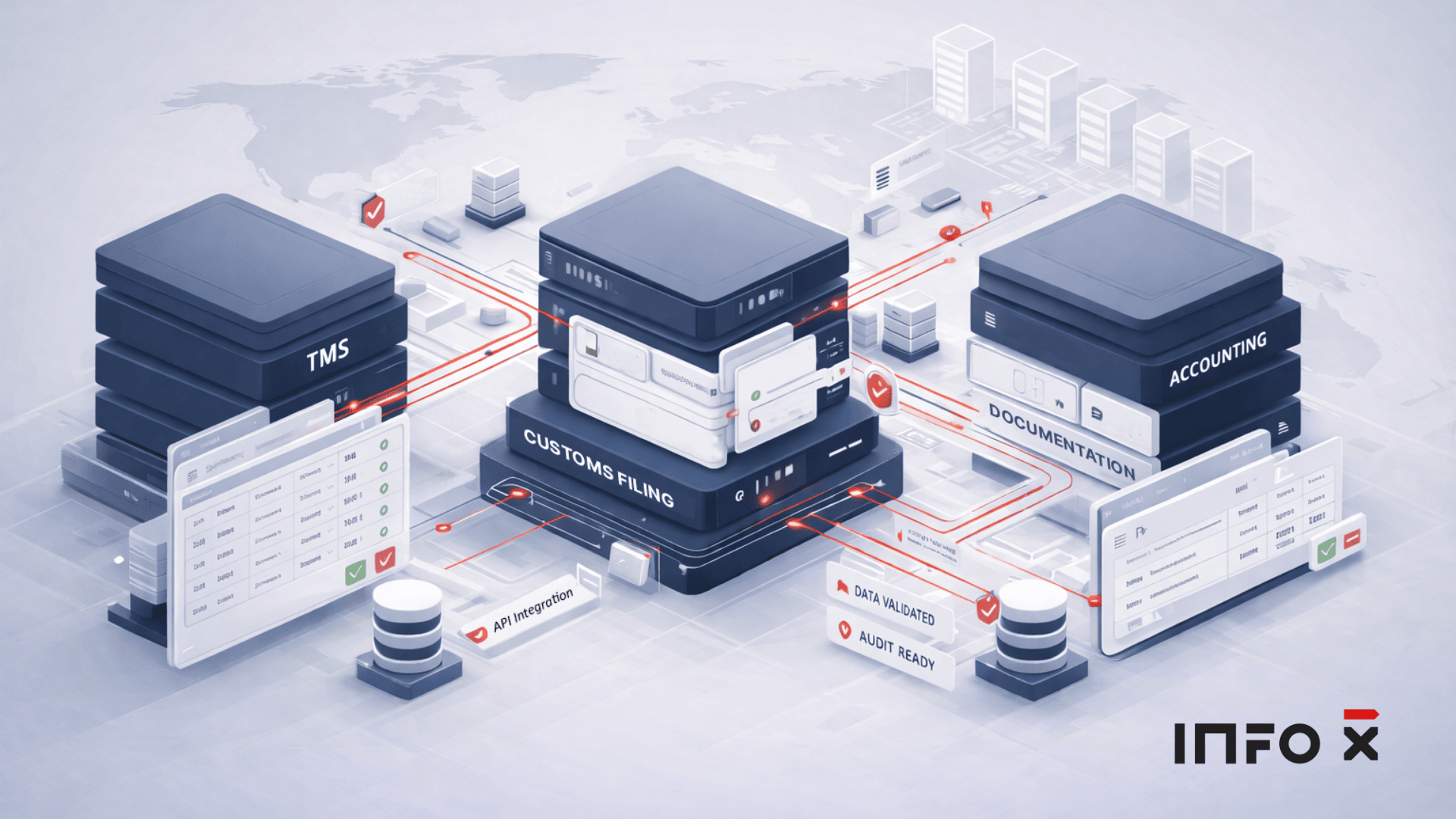
Our platform integrates directly with:
- TMS systems
- accounting platforms
- documentation workflows
Supporting:
- ISF
- AMS
- AES
- ICS2
- MPCI
All from a single, consistent data foundation.
The result isn't just faster filing. It's fewer corrections, cleaner audits, and calmer operations.
When Integrated Customs Software Becomes Essential
Integration stops being optional when:
- volumes grow
- compliance tightens
- teams scale
- audits become frequent
- margins matter more
At that point, disconnected systems aren't just inefficient — they're risky.
If your customs process still depends on:
- manual checks
- spreadsheets
- last-minute fixes
- reconciliation after the fact
then the problem isn't effort or expertise. It's the lack of a connected system.
Explore how integrated customs filing with Info-X fits into your operations and existing systems.