
If you're shipping cargo across regions, you've probably noticed something changing. "Compliance" is no longer something you "fix at destination."
Today, shipments are screened before they move. In some cases, before they're even loaded.
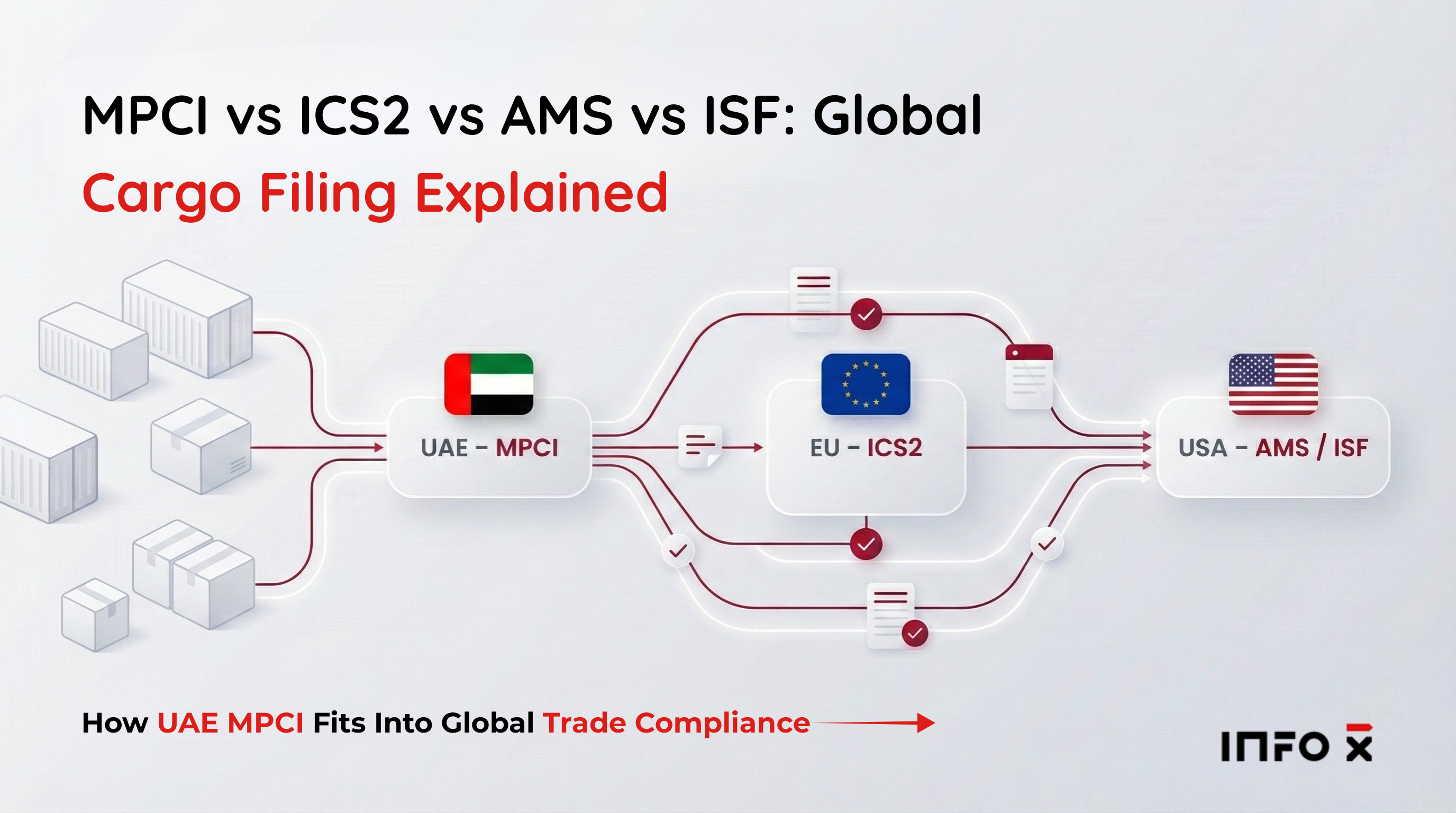
That's why programs like UAE MPCI, EU ICS2, US AMS, and ISF matter so much. They all exist to control risk early — but they don't work the same way, and treating them as interchangeable is where delays, rework, and Do-Not-Load holds usually begin.
This article breaks down how MPCI compares with ICS2, AMS, and ISF and why UAE filing needs a different approach from what most forwarders are used to.
Why governments introduced these filings in the first place
Across the UAE, EU, and US, authorities want cargo risk assessed before it moves, not after it arrives.
That means:
- Data must be submitted earlier
- More parties are held accountable
- Errors are flagged before loading, not at the destination
MPCI, ICS2, AMS, and ISF all follow this logic, but each one applies it differently.
What makes UAE MPCI different from the rest
UAE Maritime Pre-Load Cargo Information (MPCI) is a pre-loading security requirement, not a customs declaration.
In simple terms:
- Cargo data must be filed before loading at the last foreign port
- Both carriers and forwarders/NVOCCs have responsibilities
- Consolidated shipments require HBL-level accuracy
- Non-compliance can result in Do-Not-Load (DNL) instructions
Unlike some other programs, MPCI enforcement happens before the vessel sails, which makes errors far more disruptive operationally.
MPCI vs ICS2: why timing and responsibility matter
ICS2 applies to cargo entering the European Union.
MPCI applies to cargo loading for the UAE.
The key difference isn't geography — it's when risk is enforced.
The EU Import Control System 2 evaluates cargo data before it enters European customs territory, typically allowing cargo to depart from origin.
UAE MPCI evaluates cargo data before the vessel is loaded at the last foreign port, meaning errors can prevent loading entirely.
For forwarders, this distinction is critical. A single incorrect HBL under MPCI can delay an entire container, something ICS2 typically handles later in the journey.
MPCI vs AMS: similar goals, very different consequences
AMS filing in the US is well known, but it works differently.
- Feeds CBP targeting systems
- Issues fines and exams post-arrival
- Rarely stops cargo from loading
- Directly controls load approval
- Stops cargo at origin, not destination
- Requires closer coordination between the carrier and the forwarder data
This is why teams that treat MPCI like "just another AMS" often run into problems.
Where ISF fits — and why it's not comparable
ISF (10+2) is importer-focused.
MPCI is shipment-focused.
- Importer penalties
- US clearance delays
- Vessel loading
- Entire consolidations
- Multiple parties at once
They solve different problems and must be managed differently.
The real challenge: managing all of this together
Most compliance issues don't happen because teams don't understand one filing.
They happen because teams manage each filing in isolation.
Forwarders and NVOCCs today are expected to:
- File MPCI for UAE
- Handle ICS2 for Europe
- Manage AMS and ISF for the US
- Keep data consistent across all of them
That's why many operators are moving toward a centralized customs and security filing approach, rather than juggling separate systems.
Info-X supports this model through its all-in-one customs filing platform, allowing teams to manage multiple regulatory programs with consistent data, clear responsibility, and full visibility.
Why MPCI needs special attention from forwarders
MPCI is not "carrier-only compliance."
For consolidated shipments:
- Each HBL is evaluated independently
- One incorrect filing can block the entire load
- Amendments must be tracked and resubmitted carefully
This makes visibility and control far more important than speed alone.
How Info-X supports MPCI within global compliance workflows
Info-X helps logistics teams manage MPCI alongside other global programs by focusing on:
- Accurate HBL and MBL alignment
- Clear ownership of filing responsibility
- Full visibility into filing status and amendments
- Transparent, flat-fee pricing without surprises
If you're new to MPCI, start with our UAE MPCI filing guide.
If you're evaluating providers, see how our UAE MPCI filing service fits into your compliance workflow.
Key Takeaways
MPCI, ICS2, AMS, and ISF are all part of a global shift toward earlier cargo risk control.
But MPCI stands out because:
- It acts before loading
- It impacts forwarders directly
- It can stop cargo from moving altogether
Treating it with the same rigor as other programs and managing it within a unified compliance framework is no longer optional.
FAQs
MPCI is a pre-load security filing required before cargo is loaded for the UAE, while ICS2 is a pre-arrival risk screening system for cargo entering the European Union. MPCI can stop cargo from loading, whereas ICS2 typically impacts clearance after departure.
Yes. When shipments are consolidated, freight forwarders and NVOCCs are responsible for HBL-level MPCI submissions. A single incorrect HBL can delay or block the entire container from loading.
AMS is a US cargo security filing used for risk targeting and post-arrival controls. MPCI directly governs load approval and can issue Do-Not-Load instructions before the vessel departs.
No. MPCI is a security filing completed before loading. Import or transshipment customs declarations must still be filed separately after arrival.
Responsibility typically sits with the party issuing the HBL, supported by a compliance or documentation team that understands MPCI timelines and submission requirements. Info-X can provide the digital tools and workflow automation needed to streamline the filing process and ensure timely compliance.
Get UAE MPCI Filing Right from Day One
Manage UAE MPCI alongside ICS2, AMS, and ISF with complete accuracy, clear visibility, and transparent pricing. Info-X helps freight forwarders and NVOCCs stay compliant across all major security filing programs.
Learn More About UAE MPCI Filing