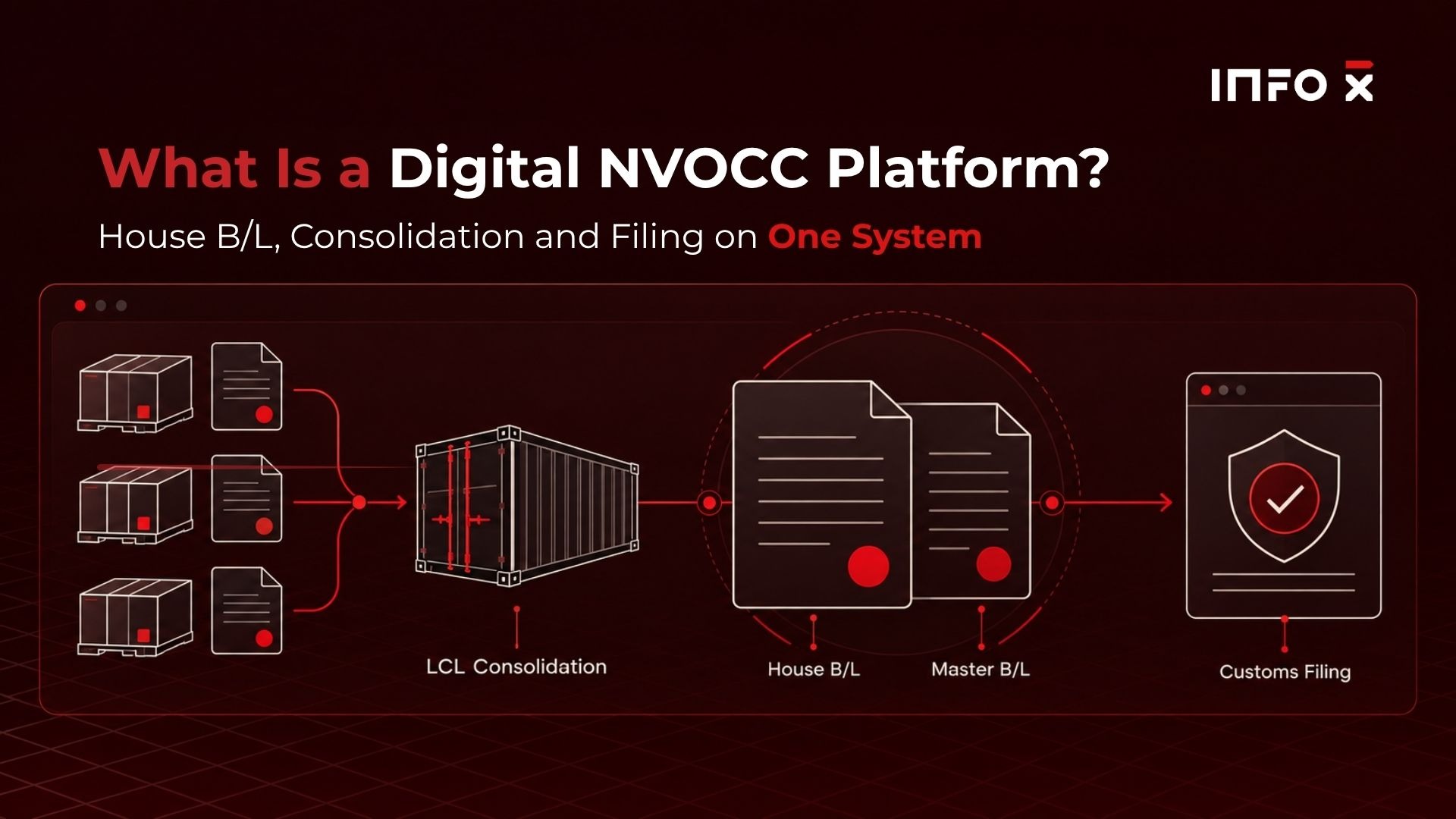
A digital NVOCC platform is a cloud system built around the workflows of a Non-Vessel Operating Common Carrier: it generates House Bills of Lading, keeps each House B/L linked to the carrier's Master B/L, manages FCL and LCL consolidations, publishes FMC tariffs, files ISF, AMS, AES, ICS2 and MPCI, tracks containers, and runs shipment-level accounting, all on one shipment record.
Most freight software is designed around a shipment someone else is carrying. An NVOCC is in a different position. It issues its own House Bill of Lading, assumes carrier liability under it, and answers to customs authorities as the party that manifested the cargo. Every downstream task, from the arrival notice to the invoice to the AMS house filing, hangs off that document.
That is why "NVOCC software" cannot be a forwarding TMS with a bill of lading template bolted on. The bill of lading is not an output at the end of the process. It is the record everything else has to reconcile against. This article explains what a digital NVOCC platform does differently, layer by layer, and gives you the capability set to evaluate any vendor against.
What a digital NVOCC platform actually is
A digital NVOCC platform is a single system where the House Bill of Lading, the Master B/L it sits under, the consolidation it belongs to, the customs filings it generates, the container events it tracks, and the invoice it produces all read and write the same shipment record. Data enters once at booking and flows through documentation, compliance, visibility and finance without being re-typed.
That "one record" condition is the whole definition. A stack of separate tools that each handle one job well is not a digital NVOCC platform, however good the individual tools are, because the reconciliation work between them lands on the operations desk. The platform exists to remove that work, not to redistribute it.
The bill of lading is what makes it different
A freight forwarder arranging carriage receives a bill of lading from the carrier and passes a copy to its customer. An NVOCC issues one. It is the carrier on the House B/L, which means it carries the contractual and regulatory obligations that come with being named as such. When the cargo description on the House Bill does not match the description on the AMS house manifest, the NVOCC, not the shipper, receives the query from CBP.
This is the reason NVOCC software is built around the bill you issue rather than the one you receive. The House B/L has to be generated from the shipment record itself, so the party details, container and seal numbers, commodity description and terms on the document are the same values the platform later sends to customs and prints on the invoice. When the House Bill is produced from a template outside the system, three copies of the same data exist by the time the container sails, and only one of them is under control.
Master and House linkage is the second half of the same requirement. Customs authorities cross-reference the two levels automatically. CBP checks AMS house data against the master manifest, and NAIC checks MPCI HBL data against the carrier's MBL submission. When the platform maintains the pairing on every shipment, filings reference the right Master B/L without anyone looking it up, and an audit question resolves from one screen instead of an email search.
Digital NVOCC platform vs forwarder TMS
The two share more than they differ. Rate management, booking, tracking, a customer portal and accounting are needed by any operator moving ocean freight. The split happens above that shared layer, and it becomes decisive the moment ocean volume climbs and the number of House Bills per week outgrows what a documentation team can reconcile by hand. That threshold is what separates an NVOCC TMS from a forwarder TMS in practice, not the feature list on a vendor's website.
| Capability | Generic freight software | Digital NVOCC platform |
|---|---|---|
| House B/L generation | Often absent or template-only | Generated from the shipment record, consistent with filings and invoices |
| Master and House linkage | Tracked manually outside the system | Maintained on every shipment, visible in one view |
| LCL consolidation | Multi-shipper containers handled as separate bookings | Managed as consolidations with clean per-shipper documentation |
| FMC tariff publishing | Not addressed | Dedicated tariff publishing aligned to quoted rates |
| Customs filings | Third-party tools, manual re-entry | ISF, AMS, AES, ICS2, MPCI from the same shipment data |
| Rates, booking, tracking, finance | Generally covered | Covered, on one record from quote to invoice |
| Managed back office | Software only | 24x7 operations team working inside the platform |
Capability framework based on NVOCC operating requirements. "Generic" describes software not built for NVOCC workflows, not any specific vendor.
Consolidation: where generic tools break first
A multi-shipper LCL container is one Master B/L covering several House B/Ls, several sets of commodity data, several customs filings and several invoices. Generic software sees several disconnected bookings that happen to share a container number. The per-shipper documentation, the per-shipper cost allocation and the link back to the single Master B/L all have to be rebuilt by the documentation team on every box.
A platform built for NVOCCs manages the container as a consolidation from the first booking through House B/L and arrival notice creation to shipment-level accounting. Co-loaded cargo keeps clean documentation because each House Bill is generated from its own shipment data, and clean economics because the ocean cost is allocated across shippers inside the same record that produced the invoices.
Where the risk concentrates: under pre-load regimes such as UAE MPCI and the ICS2 Entry Summary Declaration, one House Bill with a mismatched HS code or an incomplete consignee address can hold the whole container at the origin terminal. Every shipper in that box misses the vessel. Consolidation management is a compliance function, not just a documentation convenience.
Customs filings from the House B/L, not from a second entry
ISF, AMS and AES for US trades, ICS2 for EU-bound cargo and MPCI for the UAE each need the same core data: shipper and consignee with structured addresses, container and seal numbers, HS codes, commodity description, package count, gross weight, vessel and voyage, and the House and Master B/L references. All of it already sits on the House Bill the NVOCC issued.
When those programmes run as integrated customs filing from the shipment record, the filing is a triggered workflow rather than a separate task, and the re-keying step that produces most rejections and cross-level mismatches disappears. A reroute, a late seal change or an amended consignee reaches the filing queue because it was changed on the record, not because someone remembered to update a second system before cut-off.
FMC tariff publishing belongs in the same discussion. An NVOCC operating in US trades has to keep a published tariff current with the rates it actually quotes, and a platform that holds both the rate and the tariff on the same data keeps them aligned without a separate reconciliation exercise.
Tracking that writes back to the bill of lading
Container events are only useful to an NVOCC if they land on the House Bill they belong to. A departure confirmation, a transhipment, a port hold or a discharge event should update the shipment record, trigger the arrival notice when the vessel is inbound, and flag whether freight release can proceed. Multi-carrier shipment tracking that feeds live status into the same record the House B/L was generated from is what turns visibility into an operational input rather than a separate dashboard the desk has to check.
The same events power the customer portal. Shippers search rates, book, track and pull documents against their own House Bills without emailing the operations desk, and the status-query load on the team drops accordingly.
Portal, accounting and the two personas one record has to serve
An NVOCC's platform is used by two very different audiences. The operations and documentation team lives in House Bills, consolidations, filings and cut-offs. The NVOCC's own customers, importers and exporters, want to see status, download documents and understand landed cost without learning any of that. The record is the same; the view is not, and the split in what each side needs from it is the same split that shapes a TMS for BCOs and for the forwarders serving them.
Accounting closes the loop. Shipment-level accounting from ledger through receivables, payables and reconciliation, with two-way sync to QuickBooks, SAP, NetSuite and Xero, means margin is known per shipment and per consolidation rather than discovered at month end. Carrier invoices audited against the agreed rate on the same record catch overcharges before they are paid.
See Your Trade Lanes on One Record
A demo on your own workflows: House B/L generation, Master and House linkage, consolidation, filings, tracking and accounting, with the 24x7 back office behind it.
Book a DemoHow Info-X builds the NVOCC layer natively
Info-X has served NVOCCs and freight forwarders since 2001, manages 2,000+ carrier contracts, maintains 99.5% audit-ready data and is ISO 27001 certified. It is also a tariff publisher with the FMC, which is why tariff publishing sits inside the platform rather than beside it.
The House Bill of Lading is generated from the shipment record. Master and House linkage is maintained on every shipment. FCL and LCL consolidations are managed end to end. ISF, AMS, AES, ICS2 and MPCI file from the same data as the B/L and the booking. Container tracking across carriers and ports, a branded customer portal, and shipment-level accounting with ERP sync complete the stack. The same digital logistics platform serves forwarders, importers and exporters, with the NVOCC layer running natively rather than as an add-on.
What separates this from a login and a manual is the back office. A 24x7 operations team can work inside the platform on documentation, B/L and arrival notice processing, filing support, tracking updates and freight bill audit, so cut-offs that ignore office hours are met, and there is still one record and one audit trail. Across NVOCC and forwarder operations this pairing has delivered a 60 to 80% faster quote-to-book cycle, 30 to 50% fewer manual entry errors, 15 to 25% improved on-time updates, and month-end close measured in days rather than weeks.
What to check before you call a platform "NVOCC-ready"
- Is the House B/L generated from the shipment record, or from a template the desk fills in?
- Does the Master and House pairing live in the system on every shipment, or in a spreadsheet next to it?
- Is an LCL box a consolidation with per-shipper documents and cost allocation, or several unrelated bookings?
- Do ISF, AMS, AES, ICS2 and MPCI file from the same data as the B/L, or from a second entry in a third-party tool?
- Is FMC tariff publishing handled, and does it stay aligned with quoted rates?
- Do container events write back to the House Bill and trigger the arrival notice, or sit on a separate screen?
- Is accounting shipment-level with ERP sync, or exported and reconciled by hand?
- Who runs it at 3 a.m.? Software alone does not clear a cut-off.
One test in every demo: change the consignee on a House Bill inside an LCL consolidation and watch what else moves. If the AMS house data, the arrival notice, the customer portal and the invoice do not all reflect the change from that one edit, you are looking at a forwarding tool with an ocean module, not a digital NVOCC platform.
Conclusion
An FMC licence makes a company an NVOCC on paper. Operating as one means issuing compliant House Bills, keeping them linked to the Master, managing consolidations, publishing tariffs, filing on time in five programmes and accounting at shipment level, every week, against deadlines measured in hours. A digital NVOCC platform is the system that holds all of that on one record. The evaluation question is not which vendor lists the most features. It is whether the bill of lading you issue is the record the rest of the platform runs on.