
Ask any growing freight forwarder or 3PL where the pressure really comes from, and you'll rarely hear: "Too many shipments."
What you'll hear instead is quieter.
Too many emails.
Too many follow-ups.
Too many documents moving between too many hands.
Too many tasks that must be done, which don't actually move freight.
Back office work doesn't announce itself as a problem. It blends into daily operations until leaders realize that their most experienced people are spending their time maintaining flow instead of improving it.
That's usually when the question surfaces:
"Should we be outsourcing our logistics back office?"
But the better question is:
"Who can actually support our operations end-to-end without breaking continuity?"
This blog helps answer that.
Why Back Office Strain Increases Faster Than Shipment Volume
In logistics, operational complexity grows faster than revenue. As any forwarding or 3PL business scales:
- customer communication multiplies
- documentation volume increases
- compliance touchpoints expand
- follow-ups become constant
- coordination across teams becomes fragile
The result isn't visible failure. It's constant micro-friction.
And micro-friction is expensive.
End-to-end logistics back office support exists to remove that friction — but only if it's done properly.
What "End-to-End" Back Office Support Really Means
Many vendors claim to offer back office support. Few actually cover the full operational spectrum.
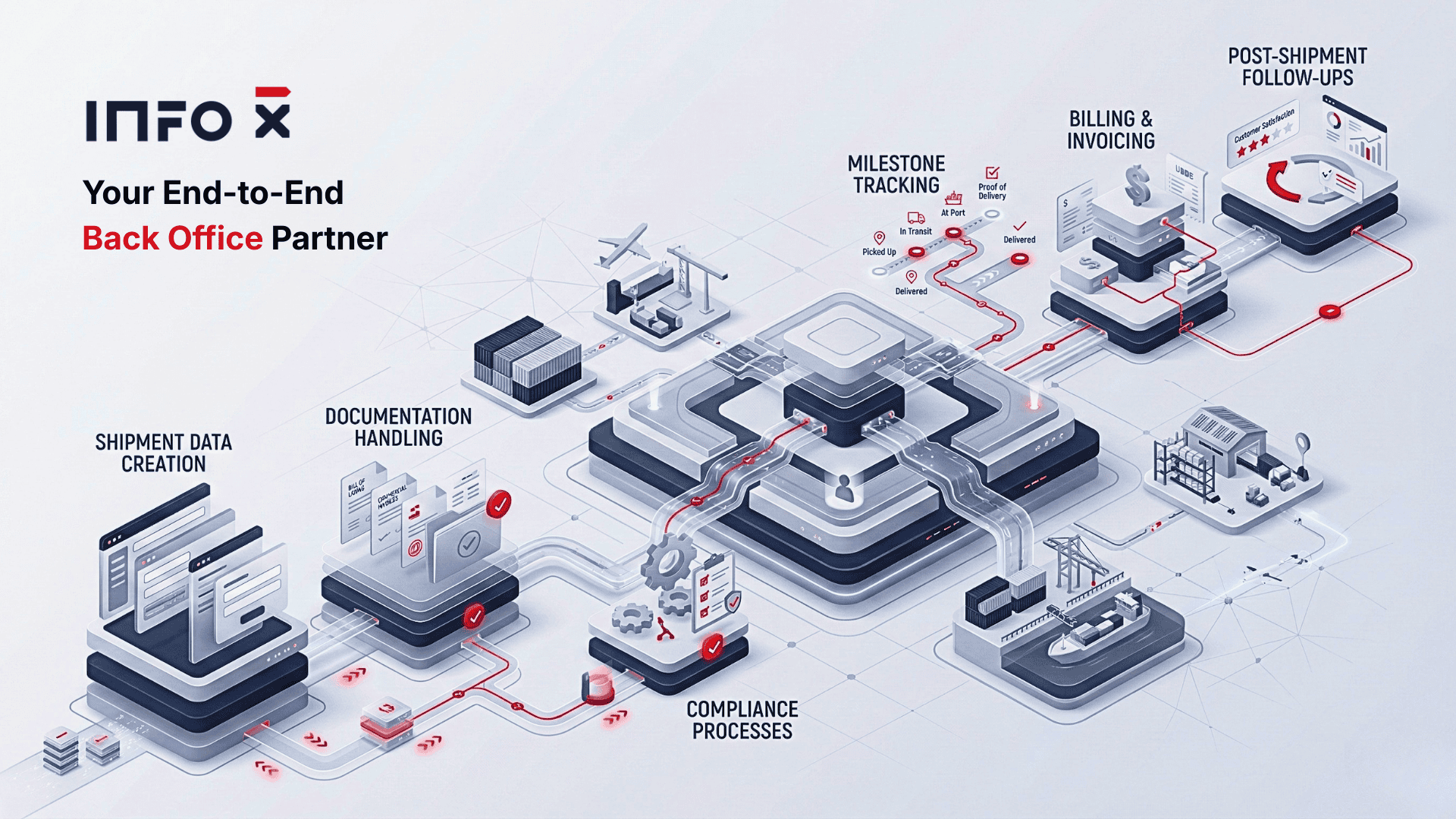
True end-to-end logistics back office support means handling entire operational workflows, not isolated tasks.
It should include:
- rate entry and quote support
- shipment data creation and validation
- documentation preparation
- customs filing coordination
- carrier and customer communication
- milestone tracking
- billing and invoicing support
- post-shipment follow-ups
Anything less is task outsourcing not operational support.
The Hidden Risk of Partial or Fragmented Back Office Outsourcing
Some forwarders try to outsource piece by piece:
- one vendor for documentation
- another for data entry
- internal teams still coordinating everything
This often adds complexity instead of removing it.
Why?
Because logistics operations rely on:
- context
- continuity
- shared understanding of exceptions
Fragmented outsourcing breaks that context.
The right back office partner must operate as an extension of your team, not an external queue.
The Core Question to Ask Before Evaluating Providers
Before comparing vendors, ask this:
"Can this partner take ownership of workflows and not just tasks?"
If the answer is no, you'll still be managing the work just from a distance.
End-to-end support should:
- Reduce internal handoffs
- standardize execution
- maintain consistency
- free your team to focus on growth and customers
Now let's look at how to evaluate companies that truly deliver this.
What to Look for in a Company Offering End-to-End Logistics Back Office Support
1. Deep Logistics Operations Understanding
Back office support only works when the provider understands:
- freight forwarding workflows
- 3PL execution cycles
- air, ocean, and ground operations
- documentation dependencies
- exception handling
Without domain knowledge, outsourcing becomes supervision-heavy.
2. Coverage Across the Full Shipment Lifecycle
A capable provider supports operations from:
- pre-shipment setup
- booking coordination
- execution support
- documentation handling
- customs-related processes
- billing and closure
If support stops mid-way, your team still carries the burden.
3. Standardized Yet Flexible Processes
Good back office partners don't just "do the work."
They:
- follow defined SOPs
- adapt to your workflows
- handle variations without escalation
- maintain consistency across shipments
This balance is critical in logistics.
4. Dedicated Teams, Not Shared Queues
True end-to-end support requires:
- dedicated resources
- continuity of knowledge
- familiarity with your customers and lanes
Shared, rotating teams lead to repeated onboarding and errors.
5. Seamless System Integration
Your back office partner must work inside:
- your TMS
- your ERP
- your documentation systems
- your communication tools
If data has to move manually between systems, efficiency is lost; hence, it should provide seamless system integration with your current TMS platform.
6. Clear Accountability and Visibility
You should always know:
- who handled what
- when tasks were completed
- where exceptions occurred
End-to-end support without transparency quickly becomes risky.
7. Ability to Scale Without Disruption
As volumes grow, the back office partner should:
- absorb increased workload
- maintain service quality
- scale teams smoothly
- avoid operational bottlenecks
If scaling causes service degradation, the model fails.
Which Types of Companies Typically Offer End-to-End Support?
In the market, providers usually fall into three categories:
1. Generic BPO Providers
They offer manpower but limited logistics understanding which again requires Heavy supervision from your internal teams.
2. Freight Forwarders Offering Back Office Services
They understand operations but may compete with you hence not always strategically ideal.
3. Logistics-Focused Back Office Specialists
These firms are purpose-built to support forwarders and 3PLs without competing for customers.
This third category is where true end-to-end support lives.
How Info-X Provides End-to-End Logistics Back Office Support
Info-X is built specifically for freight forwarders and 3PLs who want to remove operational drag without losing control.
Our back office support covers:
- shipment creation and data management
- documentation and compliance coordination
- customer and carrier communication
- milestone tracking and follow-ups
- billing and post-shipment support
All delivered by:
- logistics-trained teams
- defined workflows
- system-level integration
- clear accountability
We don't just assist, we operate as part of your execution layer.
When Back Office Outsourcing Makes Strategic Sense
End-to-end support becomes especially valuable when:
- Internal teams are stretched thin
- Operational quality varies by workload
- Leadership spends time firefighting
- growth outpaces structure
At that stage, outsourcing isn't about cost reduction. It's about restoring operational clarity.
If your teams are:
- buried in coordination work
- spending time on tasks instead of outcomes
- struggling to maintain consistency as volumes grow
- stretched between operations and growth
Then the question isn't whether to outsource. It's whether your current setup allows your best people to do their best work.
Explore how end-to-end logistics back office support from Info-X fits into real forwarding and 3PL operations quietly, consistently, and at scale.