
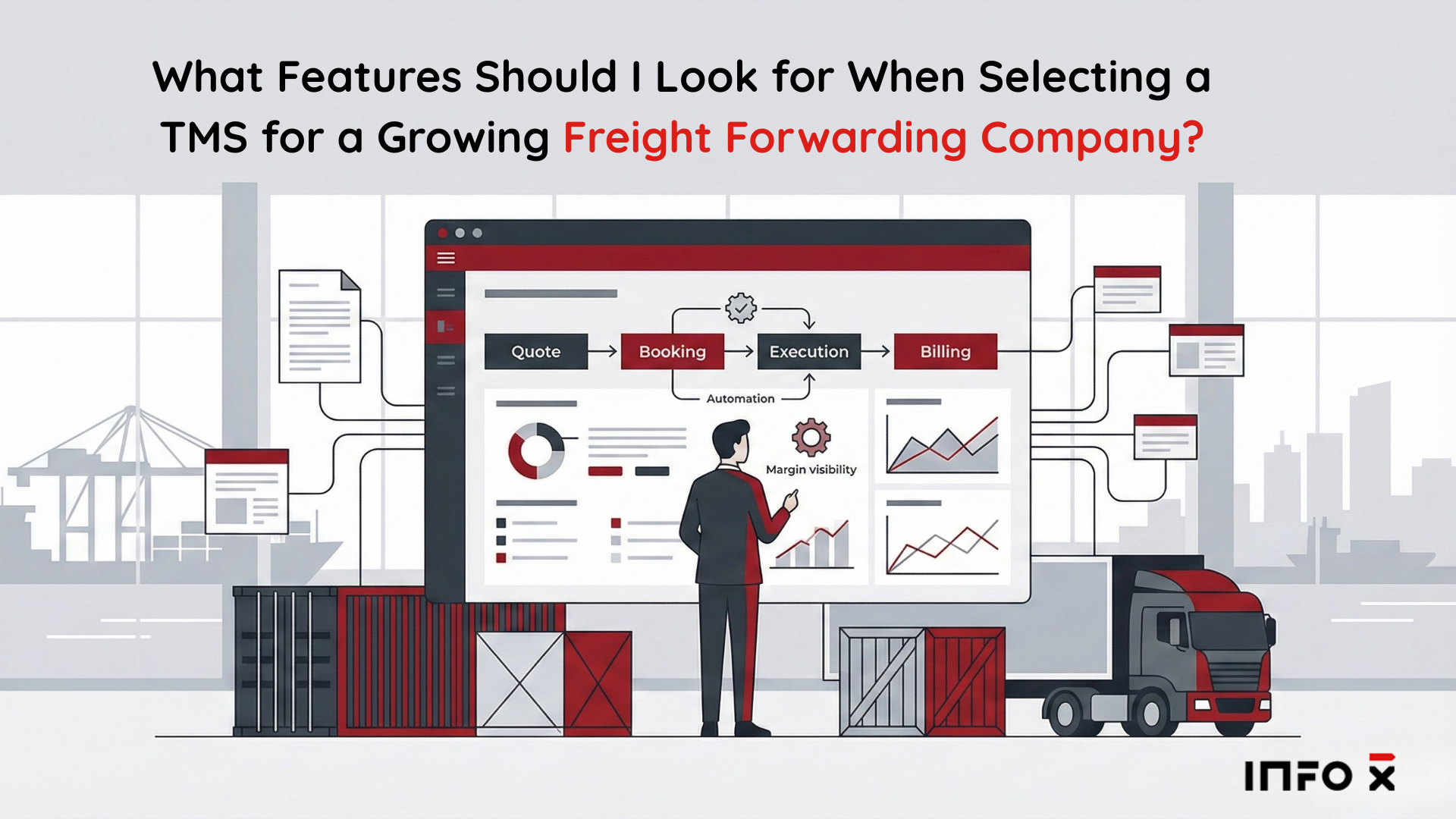
Growth rarely breaks a freight forwarding company overnight. What actually breaks first is visibility.
Quotes start slipping through emails.
Operations rely on spreadsheets that only one person understands.
Finance chases invoices instead of closing faster.
Management can't answer simple questions like "Where are we losing margin?" without pulling three reports and a phone call.
At that moment, many forwarders think: "We need a TMS."
But the smarter question is:
"What kind of TMS won't limit us 12 months from now?"
Because choosing the wrong TMS doesn't just waste money; it locks inefficiency into your growth phase, when mistakes are hardest to undo.
This guide breaks down the non-negotiable features a growing freight forwarding company must look for in a TMS and how to avoid buying software that looks impressive but fails operationally.
Why "Basic" TMS Platforms Fail Growing Freight Forwarders
Early-stage forwarders often survive with:
- email-based quoting
- shared Excel files
- disconnected accounting tools
- manual follow-ups
- tribal operational knowledge
But as volumes increase, this model collapses under its own weight.
A basic TMS typically fails because it:
- handles jobs, not workflows
- stores data but doesn't connect it
- tracks shipments but doesn't explain performance
- looks fine in demos but cracks under real volume
A growing forwarder doesn't need more software. It needs a system that thinks like an operations team.
The First Question to Ask Before Looking at Features
Before comparing checklists, ask this:
"Is this TMS built for execution — or just for record-keeping?"
Because the right TMS doesn't just log shipments. It actively reduces friction across sales, operations, documentation, compliance, and finance.
Now let's break down the features that actually matter.
1. End-to-End Shipment Workflow (Not Just Job Creation)
A serious TMS must manage the entire shipment lifecycle, not isolated tasks.
Look for:
- quote → booking → execution → documentation → billing → reporting
- seamless handoffs between teams
- no duplicate data entry across modules
If your team has to retype shipment details more than once, the system is already failing.
2. Integrated Rate & Quote Management (This Is Where Growth Leaks First)
Growing forwarders lose deals not because rates are bad but because quotes aren't followed up properly or pricing logic isn't consistent.
Your TMS should support:
- centralized rate storage
- lane-based pricing logic
- customer-specific margins
- quote history and win/loss visibility
- faster turnaround without manual calculation
If quoting still lives outside the TMS, growth will stay chaotic.
3. Strong Documentation & Compliance Support
As volumes grow, documentation errors become expensive.
A reliable TMS should:
- auto-generate shipping documents
- manage BLs, invoices, packing lists
- reduce manual document handling
- align shipment data with customs filings
For forwarders handling international freight, documentation accuracy is not optional — it's reputational.
4. Automation That Actually Removes Manual Work
Automation isn't about flashy features. It's about removing repetitive human effort.
Look for automation in:
- shipment creation
- document generation
- status updates
- internal handoffs
- customer notifications
If automation creates more exceptions than it solves, it's not real automation.
5. Visibility Across Teams (Sales, Ops, Finance & Marketing So Everyone Sees the Same Truth)
A growing company cannot afford data silos.
Your TMS must provide:
- a single source of truth
- real-time shipment status
- shared dashboards across departments
- clear ownership at each stage
6. Financial & Margin Visibility Built Into Operations
One of the most dangerous phases for a growing forwarder is profitable chaos when revenue grows but margins quietly shrink.
Your TMS should allow:
- shipment-level profitability tracking
- cost vs revenue visibility
- customer margin analysis
- delayed billing prevention
If finance only reviews numbers at month-end, you're already late.
7. Scalability Without Process Rework
A growing forwarder should never hear:
"We'll need a new system once you cross X volume."
The right TMS:
- supports increasing shipment volumes
- adapts to new trade lanes
- handles multi-branch operations
- supports additional services (air, ocean, trucking, customs)
Scalability is not a future feature, it must exist from day one.
8. Integration With External Systems
No TMS operates alone. It should integrate with:
- accounting systems
- carrier platforms
- customs filing tools
- CRM systems
- emails and document workflows
A closed system becomes a bottleneck as soon as complexity increases.
9. Reporting That Answers Real Business Questions
Dashboards should not exist just to look good. A growing freight forwarder needs answers like:
- which customers are profitable?
- where do delays originate?
- which lanes perform best?
- where do we lose time or margin?
If reporting requires manual exports, insights arrive too late.
10. A Vendor That Understands Freight — Not Just Software
This is often overlooked. A TMS provider must understand:
- real forwarding workflows
- operational edge cases
- compliance implications
- growth-stage challenges
Software built without freight experience always shows cracks under pressure.
How Info-X TMS Is Designed for Growing Freight Forwarders
Info-X TMS is built specifically for forwarders who are past survival mode and entering structured growth.
Our platform focuses on:
- end-to-end operational flow
- intelligent automation
- unified data across teams
- margin and performance clarity
- integration with customs and compliance workflows
It's not designed to impress in a demo — it's designed to perform under real operational load.
The Moment to Act Is Earlier Than Most Forwarders Think
Most companies wait until:
- errors increase
- teams burn out
- customers complain
- margins erode
That's already too late.
The right TMS doesn't just support growth, it prepares your organization for growth before it becomes painful.